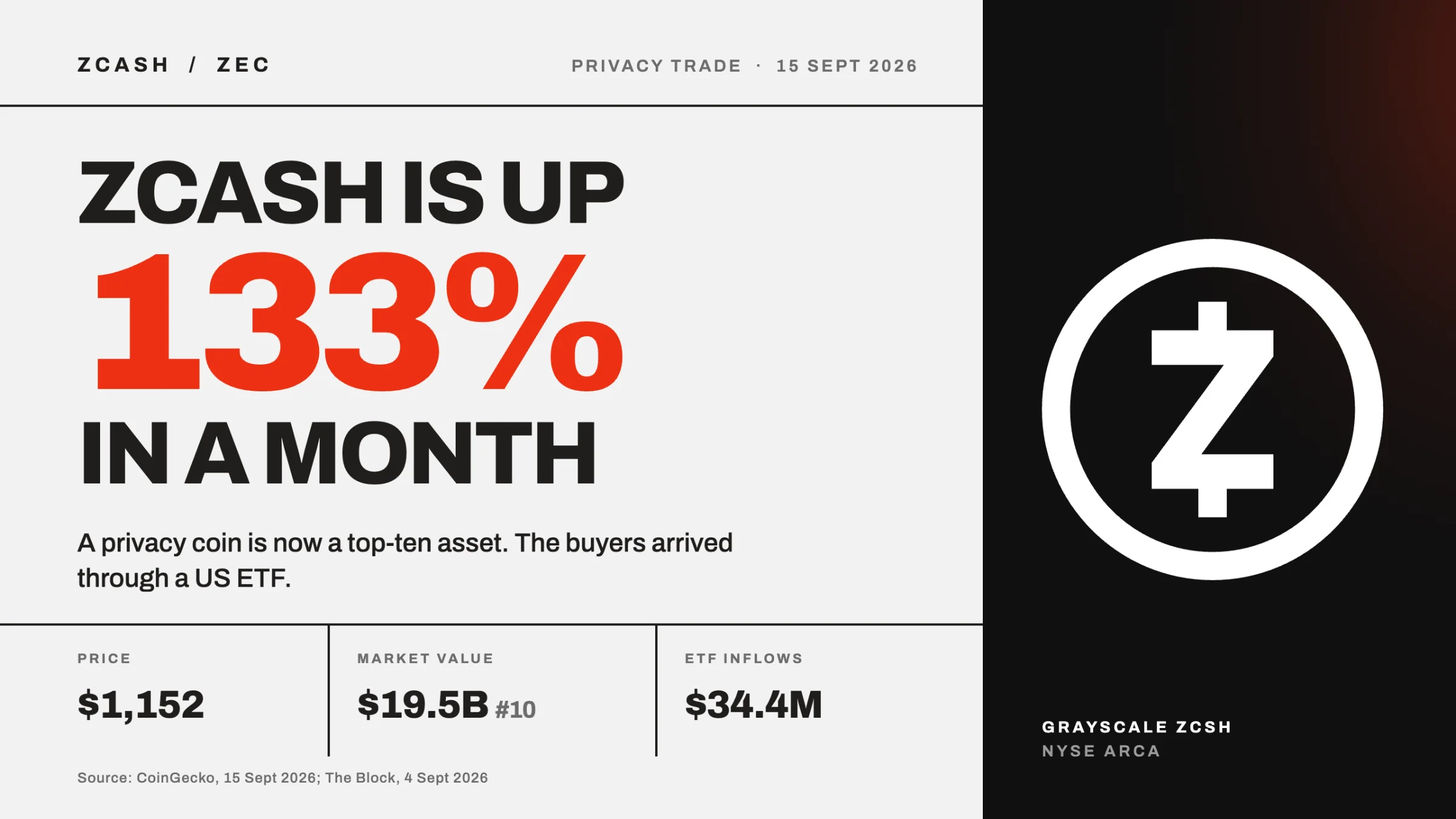
The best-performing large crypto asset of the past month is a coin designed to make transactions unreadable.
Zcash trades at 1,152 US dollars on 15 September 2026, up 133 per cent over thirty days, with a market value near 19.5 billion dollars. That puts a privacy coin inside the ten largest crypto assets in the world.
The detail that makes this interesting is not the price. It is how people are buying it.
Key Facts
Price: ZEC at 1,152 dollars on 15 September 2026, up 133 per cent over thirty days and roughly six times its March level.
Rank: tenth-largest crypto asset by market value, at about 19.5 billion dollars.
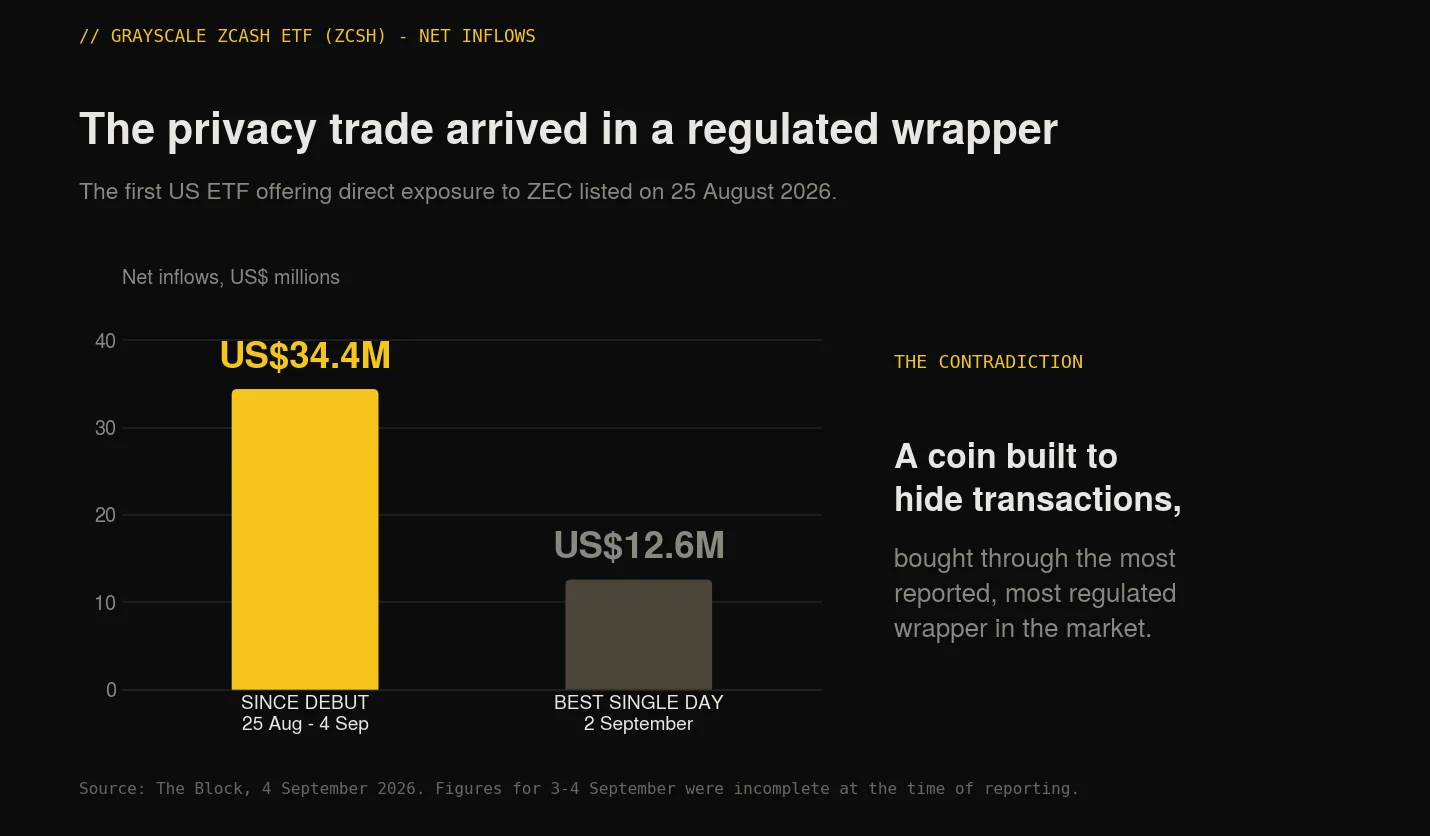
The ETF: the Grayscale Zcash ETF (ZCSH) listed on NYSE Arca on 25 August 2026, converted from Grayscale's Zcash Trust. It is the first US ETF offering direct exposure to ZEC.
Flows: about 34.4 million dollars of net inflows from debut through 4 September, with 12.6 million on 2 September alone.
The distance left: ZEC's record is 3,192 dollars, set on 28 October 2016. Today's price is roughly a third of that.
![The best-performing large crypto asset of the past month is a coin designed to make transactions unreadable. Zcash trades at 1,152 US dollars on 15 September 2026, up 133 per cent over thirty days, with a market value near 19.5 billion dollars. That puts a privacy coin inside the ten largest crypto assets in the world. The detail that makes this interesting is not the price. It is how people are buying it. ## Key Facts **Price:** ZEC at 1,152 dollars on 15 September 2026, up 133 per cent over thirty days and roughly six times its March level. **Rank:** tenth-largest crypto asset by market value, at about 19.5 billion dollars. **The ETF:** the Grayscale Zcash ETF (ZCSH) listed on NYSE Arca on 25 August 2026, converted from Grayscale's Zcash Trust. It is the first US ETF offering direct exposure to ZEC. **Flows:** about 34.4 million dollars of net inflows from debut through 4 September, with 12.6 million on 2 September alone. **The distance left:** ZEC's record is 3,192 dollars, set on 28 October 2016. Today's price is roughly a third of that. [[ CHART 1 HERE - upload 1.png, then delete this line ]] Chart 1: Zcash's move through 2026 against its 2016 record. Sources: CoinGecko, 15 September 2026; The Block, 4 September 2026. ## The contradiction at the centre of this Zcash exists to let people transact without revealing amounts or counterparties. Its selling point is that the chain does not tell you what happened. The money driving it to a ten-year high is arriving through an exchange-traded fund listed on the New York Stock Exchange, custodied by a regulated firm, reported daily, and bought inside brokerage accounts that know exactly who their customers are. Investors are not buying privacy. They are buying **exposure to the price of privacy**, through the most surveilled instrument available. That is not hypocrisy. It is a fairly precise signal about who the marginal buyer now is. Retail wallets that actually use shielded transactions do not show up in ETF flow data. Institutions that want the trade without the compliance exposure of holding the asset do. [[ CHART 2 HERE - upload 2.png, then delete this line ]] Chart 2: net inflows into the Grayscale Zcash ETF since its debut. Source: The Block, 4 September 2026. ## Why now Three things happened at once, and the order matters. **Access came first.** For most regulated funds and wealth platforms, buying ZEC directly was not an option - not because it was illegal, but because custody and compliance sign-off for a privacy asset is difficult. An ETF removes that problem by moving it to the issuer. **The macro backdrop made privacy a theme rather than a niche.** This is a year in which the US Department of Justice has been tracing crypto proceeds across borders and filing forfeiture actions, and in which sanctions enforcement has reached further into digital assets than before. When the visible chain becomes an evidentiary tool, the market prices the alternative. **Miners followed the price, then ran into each other.** Network computing power rose from around 25 GSol/s in late August to briefly above 30 GSol/s. More hashrate competing for the same block rewards means thinner margins: one commonly used mining rig produced an estimated 708 dollars of gross revenue per megawatt-hour in early September, about 3 per cent below the 727 dollars it managed on 24 August - when ZEC was cheaper. Rising price, falling unit economics. That is what a crowded trade looks like from the inside. ## The honest counterweight Three things belong next to the headline. **It is still 64 per cent below its record.** A ten-year high is a real achievement and also a reminder that holders from 2016 are not whole. **The last week went nowhere.** ZEC is down slightly over seven days even while up 133 per cent over thirty. Almost all of the move is concentrated in a short window, which is the profile of a repricing, not a trend. **Thirty-four million dollars is small.** It is meaningful for a newly listed single-asset ETF. It is not meaningful next to the flows that move Bitcoin. Treat it as evidence of a door opening, not of a wall of money already through it. ## The question for anyone reading this in Indonesia Here is where a global rally meets local market structure, and where most coverage stops. Indonesia does not regulate crypto with a list of banned assets. It does the opposite. It runs a **positive list**: on a licensed Indonesian platform, an asset can be traded only if it appears on the official roster. The current list, Perba No. 1 of 2025, covers 851 assets, and supervision sits with OJK following the transfer from Bappebti in January 2025. [[ CHART 3 HERE - upload 3.png, then delete this line ]] Chart 3: how Indonesia's positive list works. Sources: Perba No. 1/2025 as reported by MEXC; OJK licensed-provider list, 21 April 2026. So the practical question for an Indonesian reader is not](https://pivy.sgp1.digitaloceanspaces.com/web3week-asia/article_image/1789479714370-a4ce89f50ad7-1.webp)
The contradiction at the centre of this
Zcash exists to let people transact without revealing amounts or counterparties. Its selling point is that the chain does not tell you what happened.
The money driving it to a ten-year high is arriving through an exchange-traded fund listed on the New York Stock Exchange, custodied by a regulated firm, reported daily, and bought inside brokerage accounts that know exactly who their customers are.
Investors are not buying privacy. They are buying exposure to the price of privacy, through the most surveilled instrument available.
That is not hypocrisy. It is a fairly precise signal about who the marginal buyer now is. Retail wallets that actually use shielded transactions do not show up in ETF flow data. Institutions that want the trade without the compliance exposure of holding the asset do.
Why now
Three things happened at once, and the order matters.
Access came first. For most regulated funds and wealth platforms, buying ZEC directly was not an option - not because it was illegal, but because custody and compliance sign-off for a privacy asset is difficult. An ETF removes that problem by moving it to the issuer.
The macro backdrop made privacy a theme rather than a niche. This is a year in which the US Department of Justice has been tracing crypto proceeds across borders and filing forfeiture actions, and in which sanctions enforcement has reached further into digital assets than before. When the visible chain becomes an evidentiary tool, the market prices the alternative.
Miners followed the price, then ran into each other. Network computing power rose from around 25 GSol/s in late August to briefly above 30 GSol/s. More hashrate competing for the same block rewards means thinner margins: one commonly used mining rig produced an estimated 708 dollars of gross revenue per megawatt-hour in early September, about 3 per cent below the 727 dollars it managed on 24 August - when ZEC was cheaper. Rising price, falling unit economics. That is what a crowded trade looks like from the inside.
The honest counterweight
Three things belong next to the headline.
It is still 64 per cent below its record. A ten-year high is a real achievement and also a reminder that holders from 2016 are not whole.
The last week went nowhere. ZEC is down slightly over seven days even while up 133 per cent over thirty. Almost all of the move is concentrated in a short window, which is the profile of a repricing, not a trend.
Thirty-four million dollars is small. It is meaningful for a newly listed single-asset ETF. It is not meaningful next to the flows that move Bitcoin. Treat it as evidence of a door opening, not of a wall of money already through it.
The question for anyone reading this in Indonesia
Here is where a global rally meets local market structure, and where most coverage stops.
Indonesia does not regulate crypto with a list of banned assets. It does the opposite. It runs a positive list: on a licensed Indonesian platform, an asset can be traded only if it appears on the official roster. The current list, Perba No. 1 of 2025, covers 851 assets, and supervision sits with OJK following the transfer from Bappebti in January 2025.
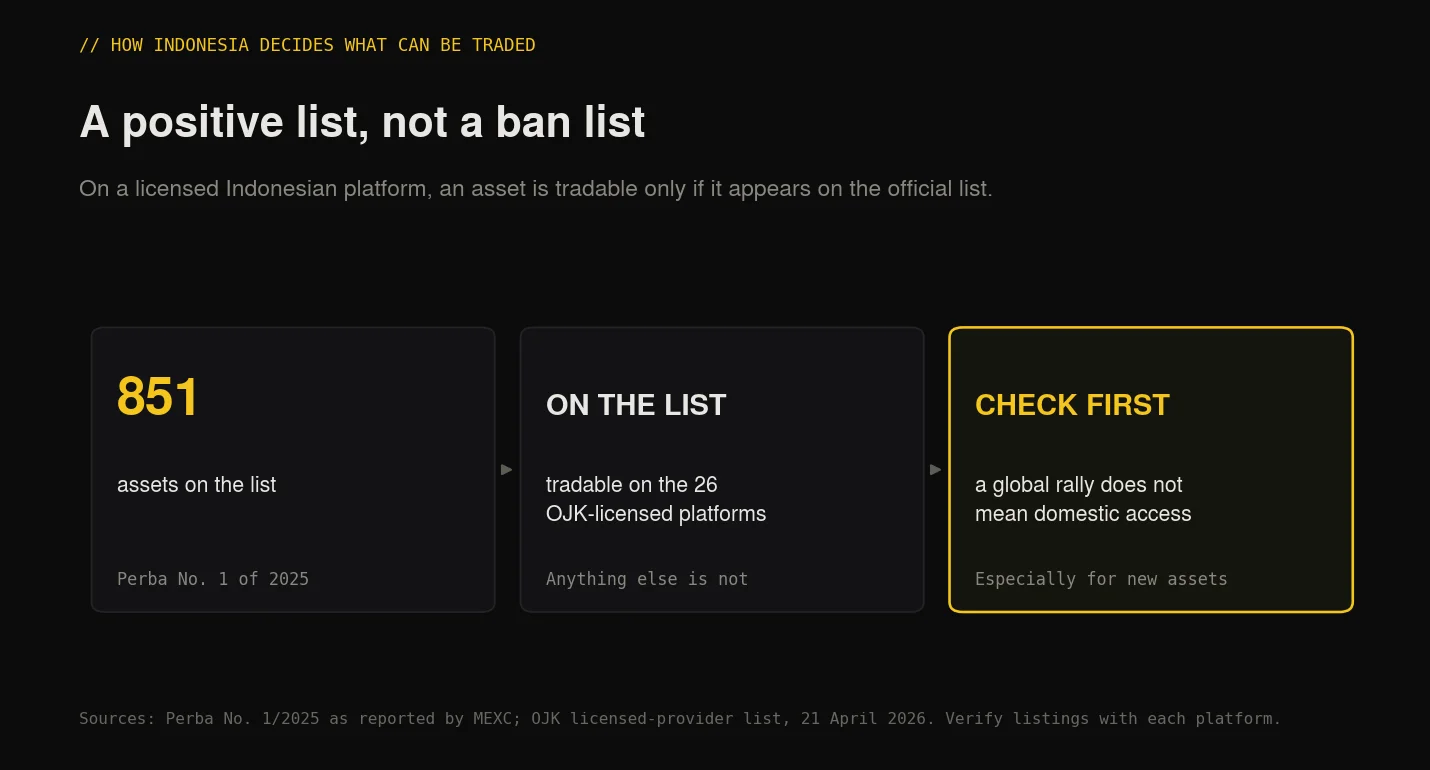
So the practical question for an Indonesian reader is not "should I buy ZEC" but "can I, here, on a licensed platform". We could not confirm from public sources whether Zcash sits on the current list. An earlier and now superseded list was reported to exclude privacy assets; whether that still holds is not something we were able to verify, and we are not going to guess about it.
That uncertainty is itself the useful finding. A global price move does not automatically mean domestic access, and the gap between the two is where Indonesian traders repeatedly get caught - chasing a headline asset, then discovering it is not available domestically and reaching for an offshore platform that sits outside every consumer protection Indonesia has built.
If you want a definite answer, ask the licensed exchange you actually use, before you plan a trade around it.
The people who can answer that question with authority - domestic exchanges, local funds, and the regulator itself - are the ones on stage at Web3 Week Asia on 11-12 November in Jakarta, where the Indonesia Crypto Outlook track exists precisely for questions like this one.
Frequently Asked Questions
Why is Zcash going up in 2026?
Three overlapping reasons: the first US spot ZEC ETF listed in August 2026, opening access for regulated buyers; heightened sanctions and law-enforcement tracing of on-chain activity has made privacy a market theme; and momentum has drawn miners and traders in behind the move.
What is the Grayscale Zcash ETF?
ZCSH, listed on NYSE Arca on 25 August 2026 and converted from Grayscale's existing Zcash Trust. It is the first US ETF offering direct exposure to ZEC, and had taken in roughly 34.4 million dollars by early September.
Is Zcash at an all-time high?
No. ZEC's record is 3,192 dollars, set in October 2016. At about 1,152 dollars it remains roughly 64 per cent below that, though it is at its highest level since 2016.
Can I buy Zcash in Indonesia?
Check with your licensed exchange before assuming you can. Indonesia uses a positive list, so only assets on the official roster may be traded on licensed domestic platforms. Whether ZEC currently appears on that list could not be confirmed from public sources for this article.
What is a privacy coin?
A crypto asset that hides transaction details such as amounts and counterparties, rather than publishing them on an open ledger as Bitcoin and Ethereum do. Zcash uses optional shielded transactions, meaning users can choose whether a given transfer is public or private.
The bottom line
The most interesting thing about Zcash in 2026 is not that a privacy coin is up 133 per cent. It is that the buying is arriving through the least private channel in finance.
That tells you the trade is being expressed by people who want the price and not the property - which is a different, and less durable, kind of demand than the one privacy advocates have spent a decade arguing for.
For Indonesian readers the second question matters more than the first. Global access and domestic access are not the same thing, and the gap is where the real risk sits. Our guide to Indonesia's crypto market covers how that market is structured, and our guide to Indonesia's crypto events covers where those conversations happen in person.
If the room you need is the one with domestic exchanges, regulators and local funds in it, Web3 Week Asia runs 11-12 November in Jakarta.
Methodology: price, market value and thirty-day and seven-day changes are from CoinGecko on 15 September 2026 and move continuously. ETF launch details, inflow figures, hashrate and mining-revenue estimates are as reported by The Block on 4 September 2026. Indonesian listing rules are per Perba No. 1 of 2025 as reported by MEXC, and the OJK licensed-provider list dated 21 April 2026. We did not independently verify asset-by-asset contents of the Indonesian list and say so in the text rather than inferring.
This article is for information only and is not investment advice.