Brent crude closed at 104.61 dollars on 11 September, up 9 percent on the week. That same day Saudi Arabia shut its East-West pipeline after attacks, per ABC News.
Bitcoin, on 13 September, sits above 77,000 dollars, having touched 79,890 the day before and given most of it back.
The two look connected, but not the way most coverage suggests. The war does not move crypto directly. It moves it through four steps, and the one that matters happens in Washington on Tuesday.
Key Facts
The conflict: in its seventh month, begun 28 February 2026. A late-June ceasefire collapsed on 8 July; none is in effect.
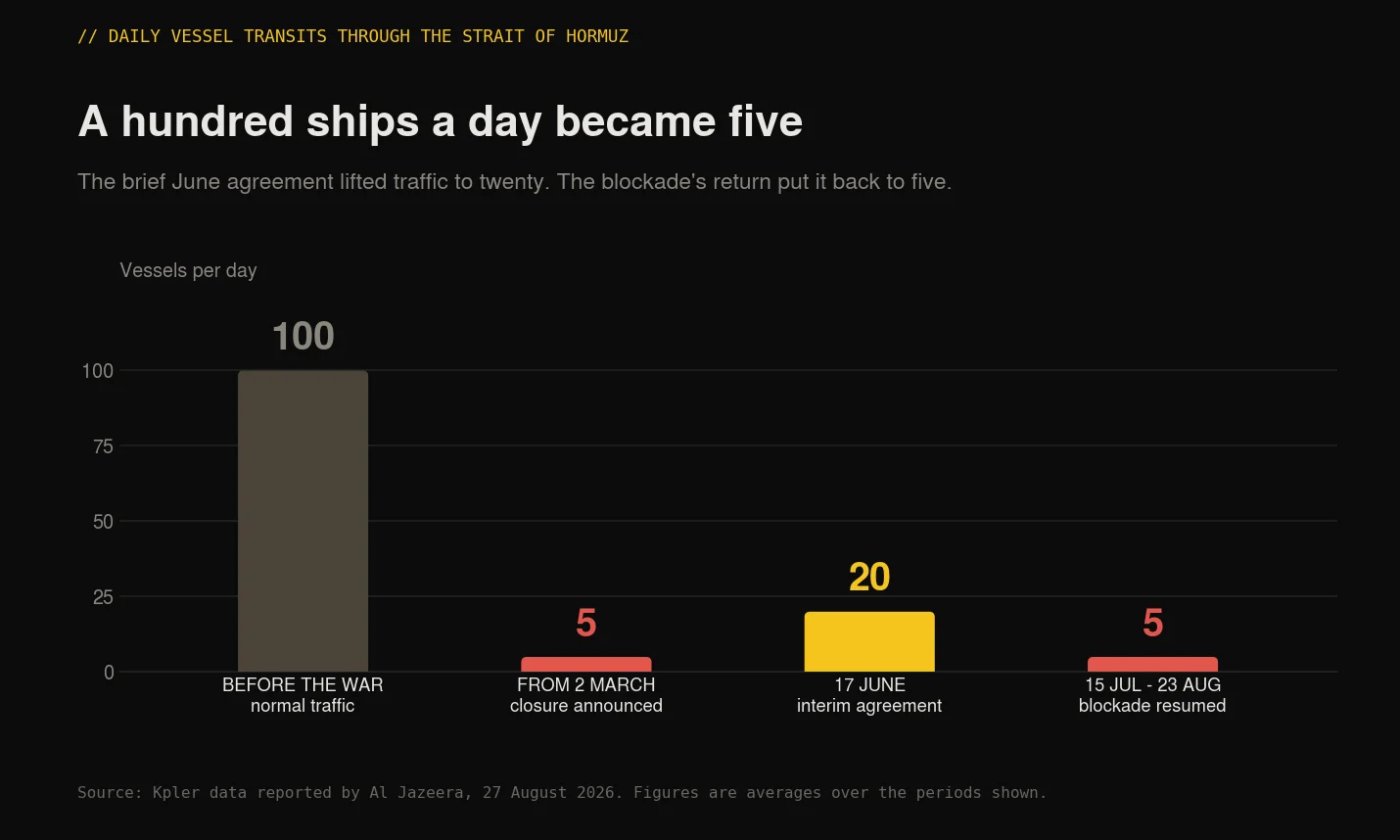
The chokepoint: the strait is effectively closed. Transits averaged five vessels a day, against about 100 pre-war - a 95 percent drop, on Kpler data via Al Jazeera.
Oil: Brent is up 17.6 percent on the month, while the IEA has cut its 2026 demand forecast by 2.5 million barrels a day - the largest contraction since the pandemic.
The Fed: markets price an 87 to 90 percent chance of a rise on 16 September.
Gold: the classic war hedge fell about 10 percent from its January record when this war began, and was still down about that much in late April, per GoldSilver.
The hedge that did not hedge
Gold is the asset every textbook names when a war starts. It hit an all-time high of 5,589 dollars in late January 2026. When the war began in late February it fell roughly 10 percent, and was still down about that much in late April.
A Swiss Bankers Association policy adviser quoted in that analysis gave the reason: gold reacts to monetary policy as much as to geopolitics. The war pushed oil up, oil pushed inflation expectations up, and higher expectations mean higher rates - bad for an asset paying nothing.
That applies to Bitcoin too. Anything with no yield competes against cash. When war makes cash pay more, "safe haven" stops being the dominant force.
The chain, one step at a time
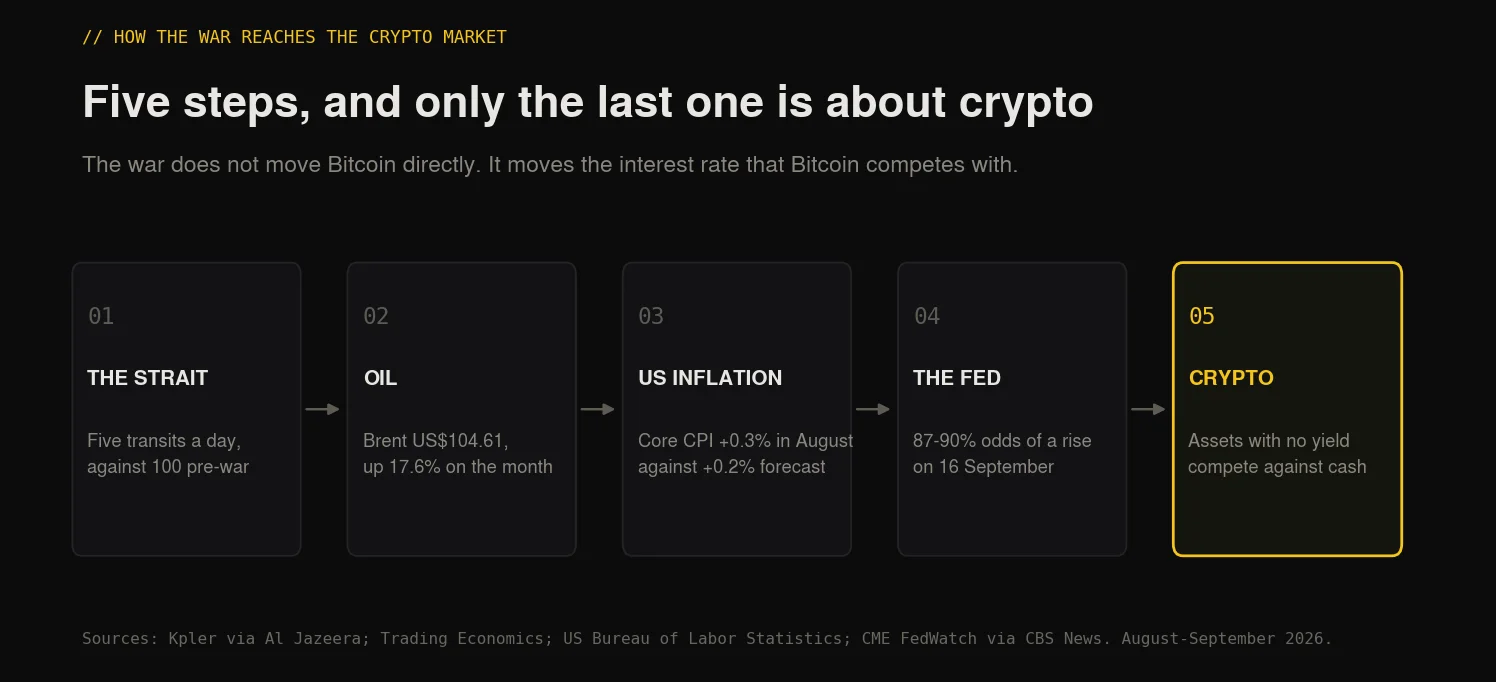
One: the strait. About five vessels a day get through, against roughly 100 pre-war - a supply problem, which is why it shows up in price rather than volume.
Two: oil. Brent above 104 dollars. Energy is an input to almost everything, so it does not stay in the energy column. It is not one-directional either - the IEA demand cut is why oil has been violent in both directions rather than simply rising.
Three: US inflation. Core inflation ran 0.3 percent in August against a 0.2 percent forecast - the report's only miss. Economists quoted by CBS News named energy spillover as the worry.
Four: the Fed. That single decimal moved the odds of a rise on 16 September to roughly 87 to 90 percent. This is the step that reaches crypto.
Read it backwards and the week makes sense: Bitcoin did not fall because tankers were attacked, but because the attacks made a rate rise near certain.
What this means in Indonesia
Bank Indonesia has been trading against this chain since May, and said so. Its May statement named the Middle East war as the reason for raising the BI-Rate, citing capital outflows from emerging markets into US bonds and the depreciation pressure that follows.
The rate has been 5.75 percent since June. If the Fed raises on Tuesday the gap narrows, and the rupiah feels it before any crypto chart does - two opposing pulls at once: rupiah deposits paying more, and a weaker rupiah making dollar assets look defensive. Which wins is set in Washington and Tehran rather than Jakarta.
Teams here need both halves of the chain, and those conversations usually happen in different rooms. The Indonesia Crypto Outlook track at Web3 Week Asia, 11-12 November puts domestic exchanges, funds and regulators on one stage.
What to watch
The Oman talks. Iranian state media say Tehran is meeting Gulf states in Oman on a temporary shipping arrangement through Hormuz. Any movement goes straight into the oil price.
Tuesday 16 September. The Fed decides. The rise is close to priced in, so the vote split matters more: July was 9-3, with three dissents for a rise.
Frequently Asked Questions
Does war make Bitcoin go up?
Not reliably. In this conflict neither gold nor Bitcoin behaved as the safe-haven story predicts. Gold fell about 10 percent from its record when the war began. The dominant force has been rate expectations, not geopolitical demand.
How does the Iran war affect crypto prices?
Indirectly, in four steps: the Hormuz closure cuts oil supply, oil raises US inflation, inflation pushes the Fed toward higher rates, and higher rates pressure assets paying no yield. Crypto is at the end of that chain, not the start.
The bottom line
The war is not a crypto story. It is an oil story that becomes an inflation story that becomes a rate story, and only then a crypto story. Anyone trading the headline is trading step one. The market is pricing step four.
For background, see our guide to Indonesia's crypto market. The Indonesia Crypto Outlook track at Web3 Week Asia, 11-12 November in Jakarta, is built around where this chain lands here.
Methodology: conflict developments are attributed to ABC News and Al Jazeera on the dates stated. Hormuz transit figures are Kpler data via Al Jazeera, measured 15 July to 23 August 2026. Oil and crypto prices are snapshots and differ by provider and capture time. Gold analysis is per GoldSilver. Rate probabilities are market prices, not forecasts. This article covers market effects only and takes no position on the conflict.
This article is for information only and is not investment advice.