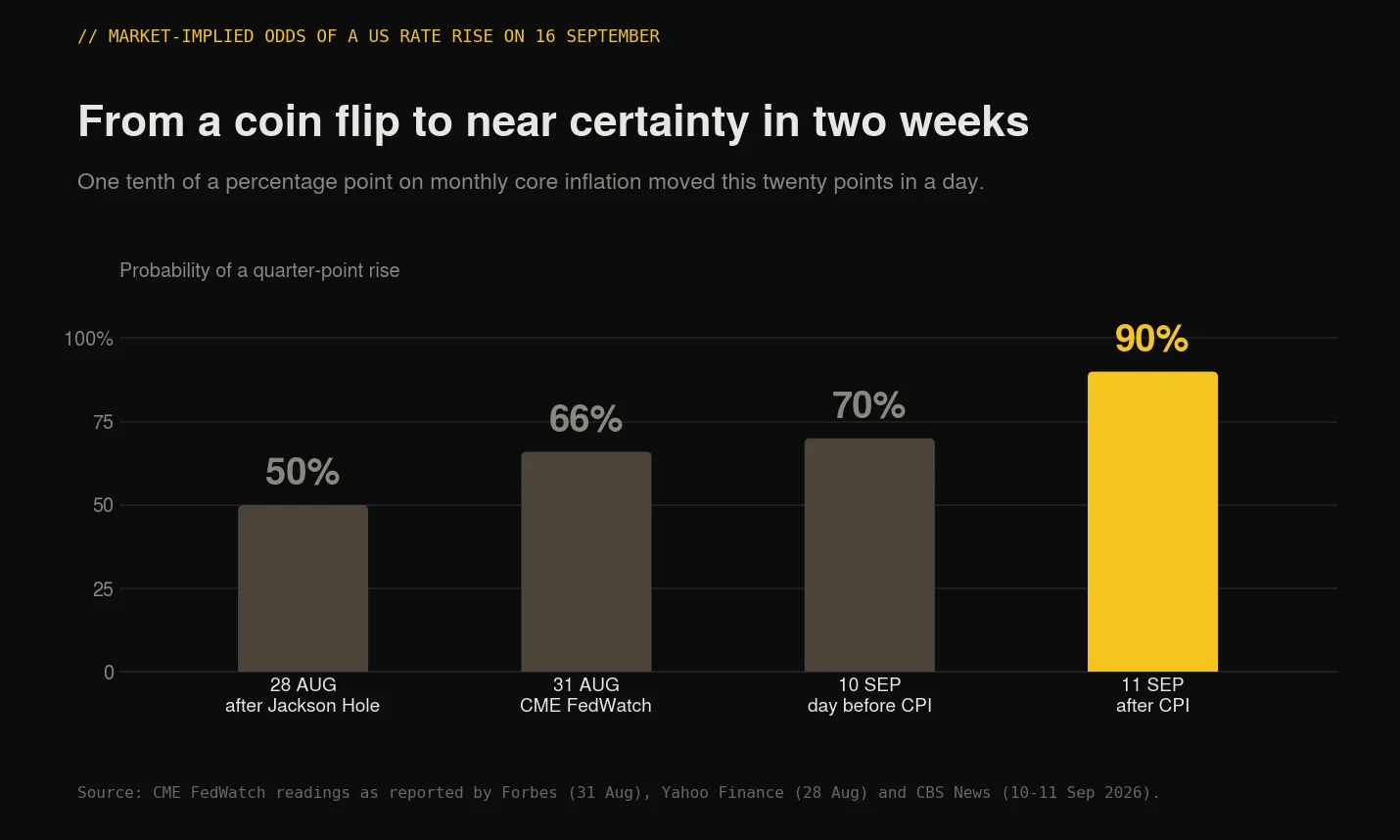
On Thursday night the US published its August inflation figures. Within hours, the market's estimate of what the Federal Reserve will do on 16 September moved from roughly 70 percent to nearly 90 percent.
The direction of that bet is the part worth pausing on. The market is not pricing a rate cut. It is pricing a rate rise.
And crypto went up.
That combination is not supposed to happen. Higher policy rates make cash and government bonds pay more, which normally pulls money away from assets that pay nothing at all - and nothing pays less interest than a Bitcoin. Yet Ether touched a seven-month high on the day the hike became close to a certainty. Either the textbook is wrong, or the market is reading something the textbook does not cover.
Key Facts
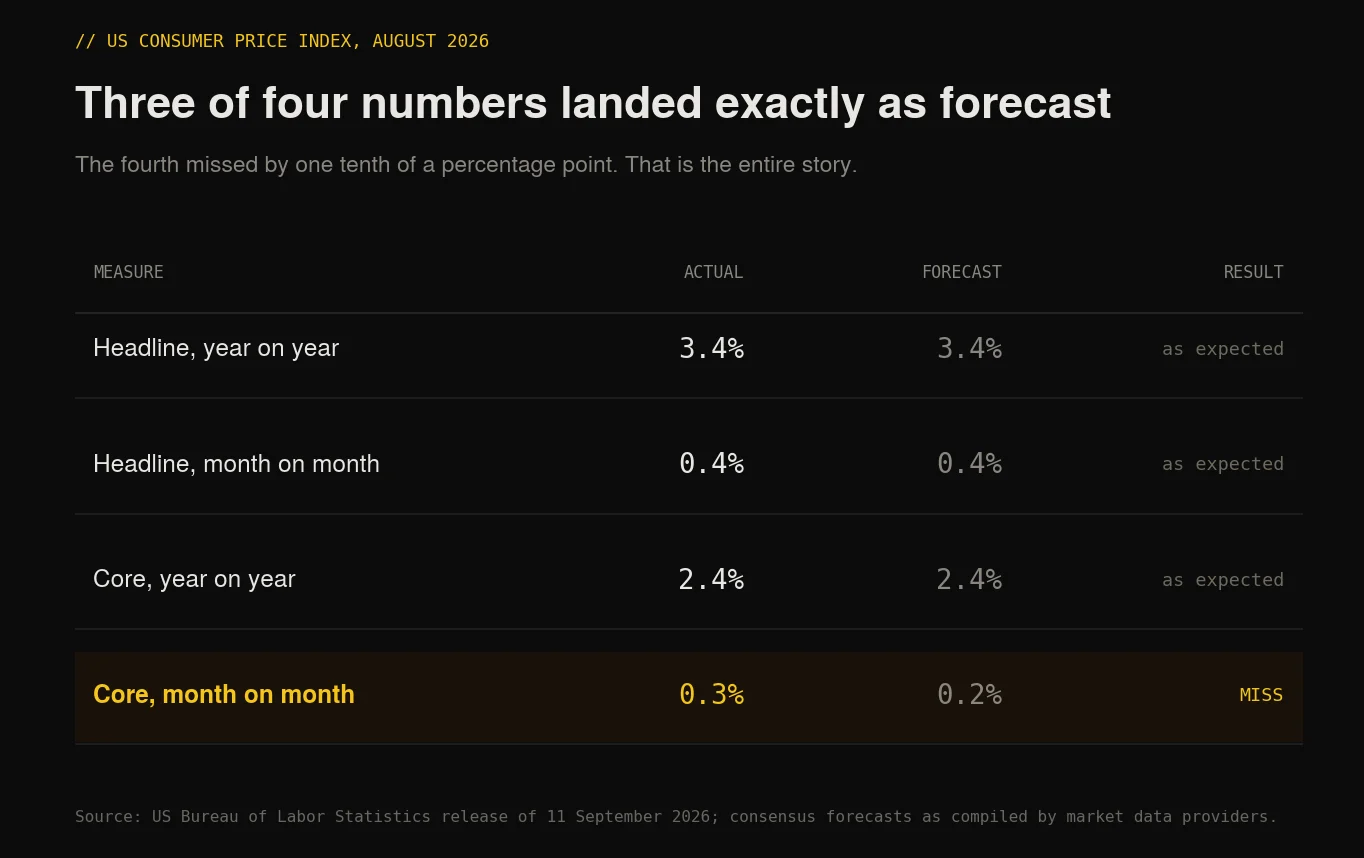
The inflation print: US headline inflation was 3.4 percent in the year to August 2026, unchanged from the previous month and in line with forecasts. Monthly headline inflation was 0.4 percent, also as expected.
The one miss: core inflation, which strips out food and energy, was 2.4 percent over the year - the softest annual reading in years - but rose 0.3 percent on the month against a 0.2 percent forecast. That single decimal point did most of the damage.
The reaction in rate markets: the probability of a rate rise on 16 September jumped to nearly 90 percent on CME FedWatch, from about 70 percent the day before.
Where rates are now: the Fed held at 3.5 to 3.75 percent on 29 July, on a 9-3 vote. A quarter-point rise would take the range to 3.75-4 percent.
The crypto reaction: Bitcoin traded roughly between 76,500 and 79,400 US dollars across the session and closed the day higher. Ether rose about 5 percent to 8 percent depending on the snapshot, reaching its highest level in seven months.
The Asian angle: Bank Indonesia already did this. It raised the BI-Rate by 50bp in May and again in June, and has held at 5.75 percent since.
What the inflation report actually said
Three of the four headline numbers landed exactly where economists expected. Annual inflation held at 3.4 percent. Monthly inflation came in at 0.4 percent. Core inflation eased to 2.4 percent over the year, continuing a disinflation trend that has been running for months.
On any ordinary reading, that is a report about inflation slowly coming down.
The exception was core inflation on the month: 0.3 percent against a 0.2 percent forecast. One tenth of one percentage point. In a normal quarter nobody outside a research desk would notice. In this one it moved roughly twenty percentage points of probability about what the world's most important central bank does next.
The reason one decimal carried that weight is that the Fed has told everyone it is watching exactly this number.
Why a rate rise is on the table at all
Most of the world spent 2025 and early 2026 discussing when rates would come down. That conversation has quietly reversed, for three reasons.
The Fed's own committee is split. When the Fed held rates in July, three regional presidents - Beth Hammack of Cleveland, Neel Kashkari of Minneapolis and Lorie Logan of Dallas - voted against holding. All three wanted a rise. A 9-3 vote is not a comfortable consensus; it is a majority holding a line.
The chair is hawkish. Fed chair Kevin Warsh said the July hold was "especially prudent at these uncertain times," and added: "This Fed will not waver. Our credibility rests on performing our duties and delivering on our responsibilities." His Jackson Hole remarks in late August were what first pushed the September hike from an outside possibility to a coin flip, according to reporting by Yahoo Finance.
Energy is the problem, and energy is political. The Fed's July statement pointed at "elevated uncertainty that owes, in part, to the conflict in the Middle East," and at supply shocks in energy. Kathy Bostjancic, chief economist at Nationwide, has warned that higher energy prices "could spill over to other goods and services and inflation expectations." Greg Daco of EY-Parthenon put the hawkish case more bluntly, arguing that the speed of disinflation is not satisfactory.
None of this is about an overheating economy. It is about a central bank that does not want to be seen tolerating an energy shock.
So why did crypto go up
Three explanations are circulating. They are not equally strong, and it is worth separating them.
The weakest: the market thinks the Fed is wrong. This is the explanation you will hear most and it should be trusted least. It assumes a market-wide view that nobody can observe.
The more plausible: certainty is worth something. For three weeks the September decision was close to a coin flip. Positions could not be sized against a 50-50 outcome. Moving to 90 percent does not make the news good; it makes it knowable. Risk assets frequently rally on the removal of ambiguity rather than on the content of it.
The most structural: the marginal buyer changed. A meaningful share of Bitcoin demand now arrives through spot ETFs, and allocation decisions inside pension funds and wealth platforms do not get re-made because monthly core inflation printed a tenth high. That money moves on quarterly mandates, not on data releases. Rate sensitivity has not disappeared, but the buyer that responds to it is a smaller share of the total than it was two years ago.
And the honest caveat: one day is not evidence. A single session's move can be noise, positioning, or an unrelated flow. The real test is what happens after 16 September, when the decision stops being a probability and becomes a fact.
The part nobody in the US is writing
Every American outlet will cover the Fed decision. Almost none will connect it to what it does to Asia. That connection is the whole point for anyone operating here.
When the Fed raises rates, the US dollar strengthens, and capital leaves emerging markets for US bonds. That is not a theory. Bank Indonesia described the mechanism in its own words when it raised rates in May, noting that deteriorating global conditions had "perpetuated capital outflows from various countries, including emerging markets, towards high-yield and safe-haven assets, particularly US bonds," which strengthened the dollar and built depreciation pressure on the rupiah.
Indonesia's response was pre-emptive and large. The BI-Rate went up 50 basis points in May, then another 50 across June - including an emergency move on 9 June, outside the scheduled calendar. Since then Bank Indonesia has held at 5.75 percent through July and August.
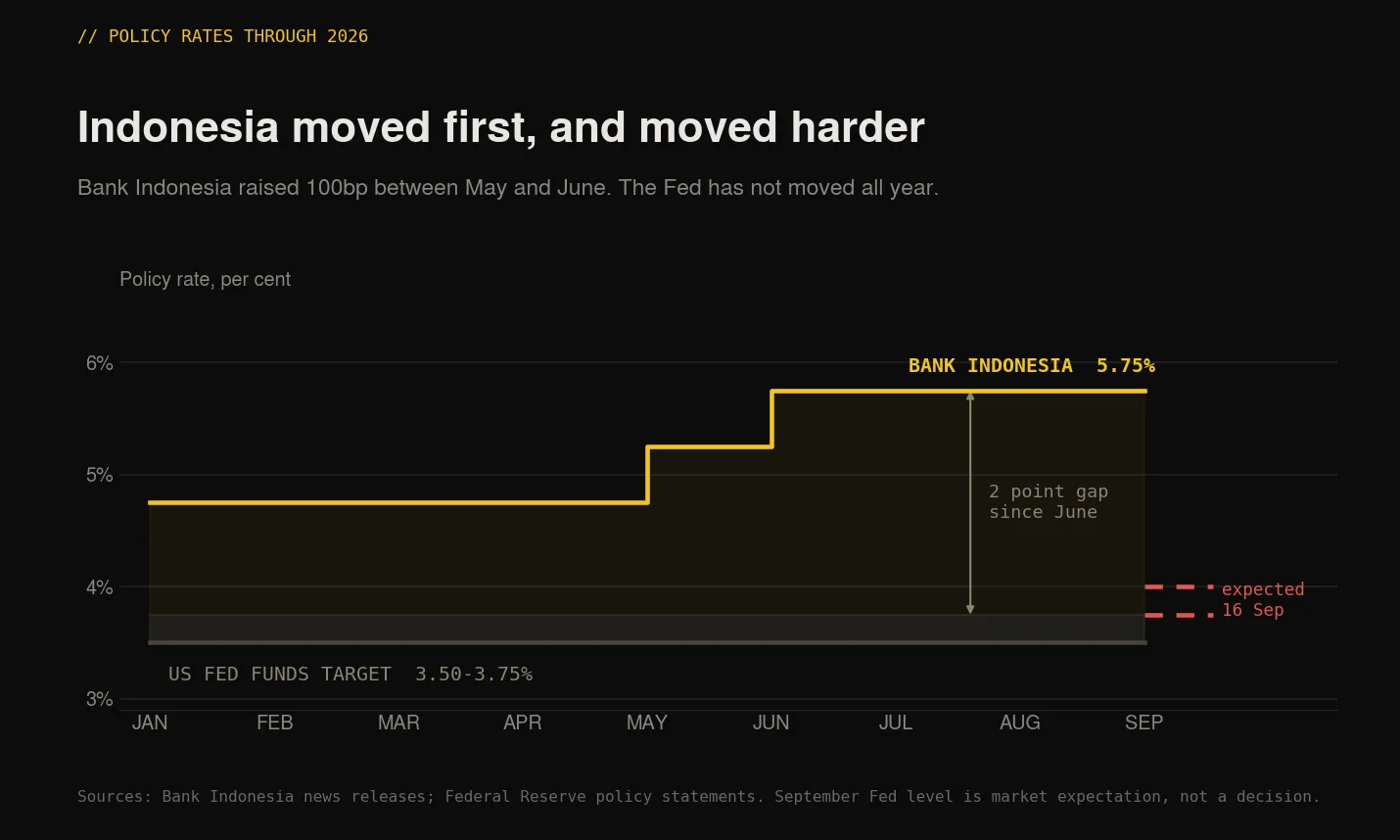
So Indonesia is not waiting to find out what the Fed does. It has already paid for the insurance. The question for anyone with exposure here is narrower and more practical: if the Fed raises on 16 September, has Bank Indonesia already done enough, or does it have to move again?
That matters for crypto specifically because Indonesian participation is overwhelmingly domestic retail, denominated in rupiah, and it behaves nothing like ETF flows. A higher domestic policy rate makes rupiah deposits more attractive at exactly the moment a weaker rupiah makes dollar-denominated assets look like protection. Those two forces pull in opposite directions, and which one dominates is the single most useful thing to understand about this market over the next two quarters.
For the background on how that market is structured, see our guide to Indonesia's crypto market.
What to watch on 16 September
The decision itself is close to priced in. Three things are not.
The vote split. July was 9-3 with three dissents for a rise. If the Fed raises and the dissents now come from the other direction, the hiking cycle is a single insurance move. If the vote is near-unanimous for a rise, it is the start of something.
The language on energy. If the statement keeps framing inflation as a supply shock from the Middle East, the Fed is treating this as temporary. If that framing drops, it is not.
What happens to the dollar in the following week. This is the number that reaches Indonesia. The decision matters here mainly through the exchange rate, and the exchange rate reaction usually takes days, not minutes.
The teams that navigate the next two quarters well will be the ones that understand both halves of that chain - what the Fed does, and what it does to rupiah liquidity. Those two conversations happen in different rooms almost everywhere in the world. The Indonesia Crypto Outlook track at Web3 Week Asia on 11-12 November puts domestic exchanges, local funds and regulators on the same stage, which is where the second half of that chain actually gets discussed.
Frequently Asked Questions
When is the next Fed interest rate decision?
16 September 2026. The Federal Reserve last met on 29 July 2026 and held its target range at 3.5 to 3.75 percent on a 9-3 vote.
Is the Fed expected to raise or cut rates in September 2026?
Raise. Following the August inflation report published on 11 September, CME FedWatch pricing put the probability of a quarter-point rise at close to 90 percent, up from about 70 percent the day before. A quarter-point move would take the range to 3.75 to 4 percent.
Why did crypto rise if the Fed is expected to raise rates?
There is no single confirmed answer. The most defensible explanations are that markets had been paralysed by a 50-50 outcome and rallied on the removal of uncertainty, and that a growing share of Bitcoin demand now comes through ETF allocations that do not respond to monthly data releases. A single session is not enough evidence to settle it.
What was the US inflation rate in August 2026?
Headline inflation was 3.4 percent over the year and 0.4 percent on the month, both in line with forecasts. Core inflation was 2.4 percent over the year and 0.3 percent on the month, against a 0.2 percent forecast.
How do US interest rates affect the Indonesian crypto market?
Indirectly, through the currency. Higher US rates strengthen the dollar and draw capital out of emerging markets, which pressures the rupiah. Bank Indonesia has responded by raising its own policy rate to 5.75 percent. For domestic crypto participants, that creates two opposing pulls: higher rupiah deposit rates compete for savings, while a weaker rupiah makes dollar-denominated assets look defensive.
What is Bank Indonesia's current interest rate?
5.75 percent, following increases of 50 basis points in May and a further 50 basis points across June 2026, and holds in July and August.
The bottom line
The story of the past week is not that inflation surprised anyone. Three of four measures landed exactly where they were forecast. The story is that one tenth of a percentage point on monthly core inflation was enough to move the world's most important interest rate decision from a coin flip to a near certainty - and that crypto rose anyway.
Whether that resilience is structural or simply relief at the end of ambiguity is not yet answerable. 16 September will start to answer it.
What is already settled is the part that matters most in this region. Indonesia moved first, raised harder than the Fed is about to, and has been holding since August. The Fed's decision will arrive here as a currency event before it arrives as a crypto event, and that is the order in which teams operating in Indonesia should think about it.
The Indonesia Crypto Outlook track at Web3 Week Asia, on 11-12 November in Jakarta, is built around exactly that question.
Methodology: policy rates and rate decisions are taken from Bank Indonesia news releases and Federal Reserve policy statements. Inflation figures are from the Bureau of Labor Statistics release of 11 September 2026. Rate probabilities are CME FedWatch readings as reported by CBS News, Forbes and Yahoo Finance on the dates stated; these are market prices, not forecasts, and they change continuously. Crypto prices are intraday snapshots from 11 September 2026 and differ between providers depending on the time of capture; ranges are given rather than single figures for that reason.
This article is for information only and is not investment advice.