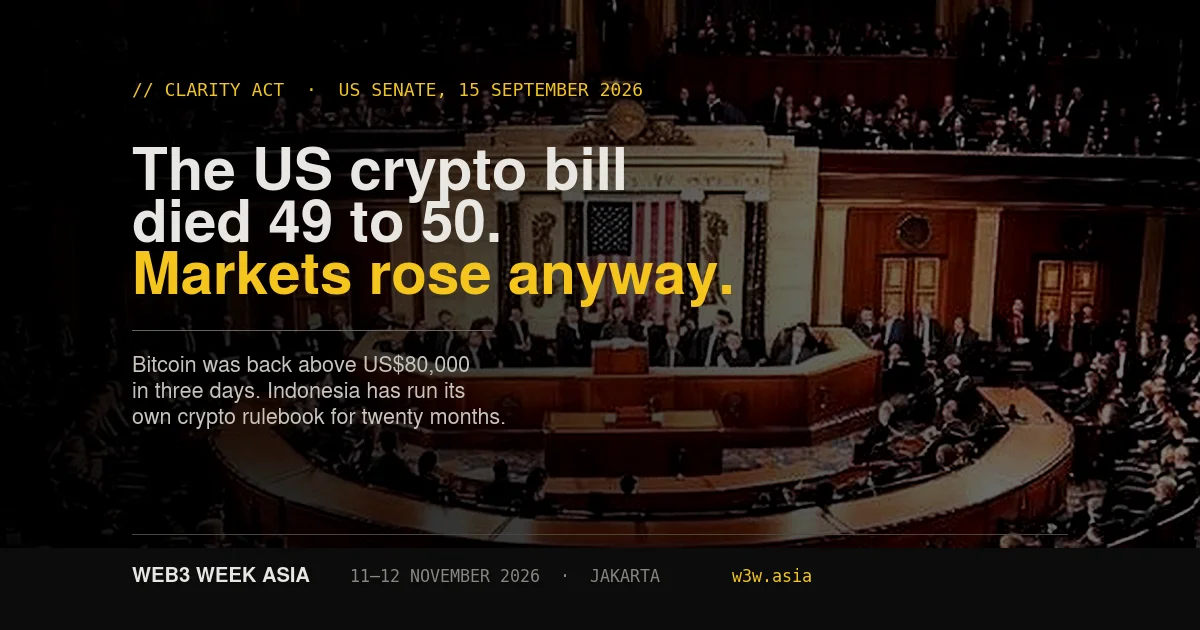
On Tuesday 15 September, the United States Senate voted 49 to 50 and killed the crypto industry's biggest legislative priority in eight years. Bitcoin fell below US$76,000 within hours. Coinbase shares lost 6.7 per cent. Circle lost 8 per cent.
Three days later bitcoin was back above US$80,000, the CFTC had filed its own crypto rules with the White House, and the market had moved on.
The interesting question is not why the Digital Asset Market Clarity Act failed. It is why it turned out to matter so much less than everyone expected, and what that says to anyone building in a market that already has rules.
The vote was never close
The bill had been moving for sixteen months. French Hill introduced it in the House on 29 May 2025. The House passed it 294 to 134 on 17 July 2025, a genuinely bipartisan margin. The Senate Banking Committee advanced its own version 15 to 9 on 14 May 2026, and Cynthia Lummis merged the Banking and Agriculture texts in late July.
Then on 15 September the cloture motion, the procedural vote that ends debate and allows the Senate to take up the bill itself, drew 49 votes. It needed 60.
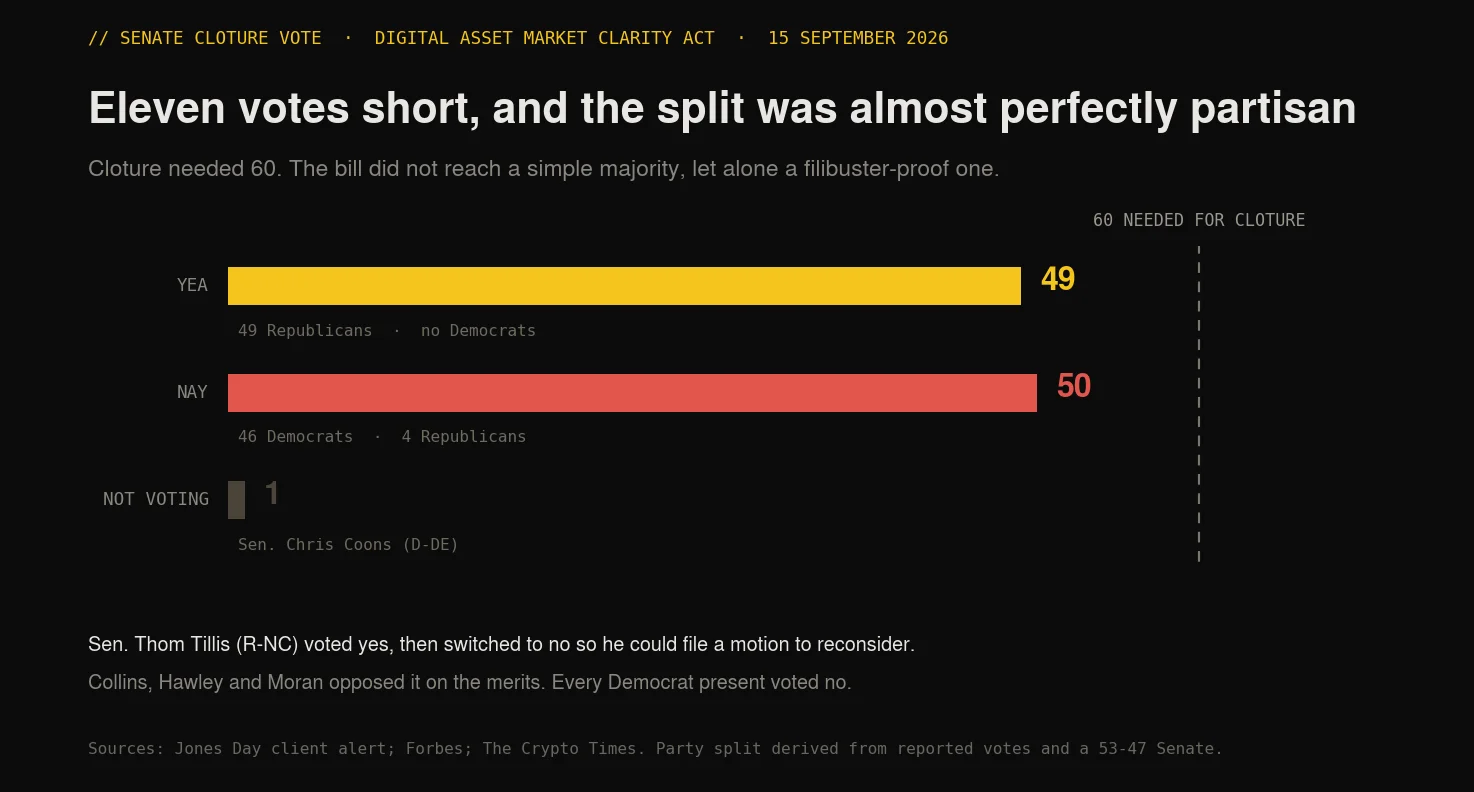
Senate cloture vote on the Digital Asset Market Clarity Act, 15 September 2026.
Forty-nine Republicans voted yes. No Democrat did. Four Republicans voted no: Susan Collins, Josh Hawley and Jerry Moran on the merits, and Thom Tillis for a procedural reason, switching his yes to a no so he could file a motion to reconsider and keep the bill technically alive. Chris Coons did not vote.
The bill would have divided jurisdiction between the SEC and the CFTC and written the first federal rulebook for exchanges, brokers and other digital asset firms. That is what the American crypto industry has been asking Congress for since 2018.
The 1.4 billion dollar problem
It did not fail over a disagreement about market structure.
On 30 June 2026 the US Office of Government Ethics released the president's annual financial disclosure, a filing running past 900 pages and covering calendar year 2025. It showed more than US$1.4 billion in income from crypto ventures, his single largest source of income that year, out of more than US$2 billion in total.
The two largest components were World Liberty Financial, the Trump family's crypto firm, and the $TRUMP memecoin licensed through CIC Digital. Published breakdowns of the internal split differ between outlets, because disclosure forms report ranges rather than exact figures. The total and the two dominant sources are consistent across reporting; the line-by-line numbers are not, and this article does not chart them.
Democrats refused to hand regulatory certainty to an industry the sitting president earns from at that scale without ethics provisions they considered enforceable. Republicans offered a late compromise requiring elected officials to divest crypto holdings or place them in a blind trust. Democrats did not accept it.
Ruben Gallego said Republicans refuse to say no to the president. Catherine Cortez Masto said critical provisions remained unresolved despite good-faith negotiation. Elizabeth Warren described a vote for the bill as a vote to bless the president's corruption.
The White House rejected that framing entirely. A spokesperson said the blame belongs to Democrats who continue to put political games over what is best for American technology. The president has denied any conflict of interest, telling CNBC there was nothing illegal and nothing wrong with the investments and noting that his children were in business long before he ran for office. The Trump Organization has called the filing a level of financial transparency unmatched in presidential history.
Both accounts are on the record. Neither side moved.
The industry did not speak with one voice
What is unusual is how many people inside crypto blamed the president rather than the Democrats.
Justin Slaughter, Paradigm. The failure of the bill begins and ends with Donald Trump.
Nic Carter, Castle Island Ventures. Trump needlessly complicated the whole process by entwining himself and his family in crypto.
Arjun Sethi, co-CEO of Kraken's parent. The bill became about ethics and had nothing to do with market structure.
Carlos Domingo, Securitize. This became a partisan issue when it did not need to be.
Not everyone agreed on where the cost lands. Anthony Pompliano warned that voting the bill down weeks before an election is a dangerous game given the effectiveness of the crypto lobby. He was pointing at Fairshake, the crypto super PAC, which held roughly US$127 million in cash at its most recent FEC filing in July.
The market took three days to decide it did not matter
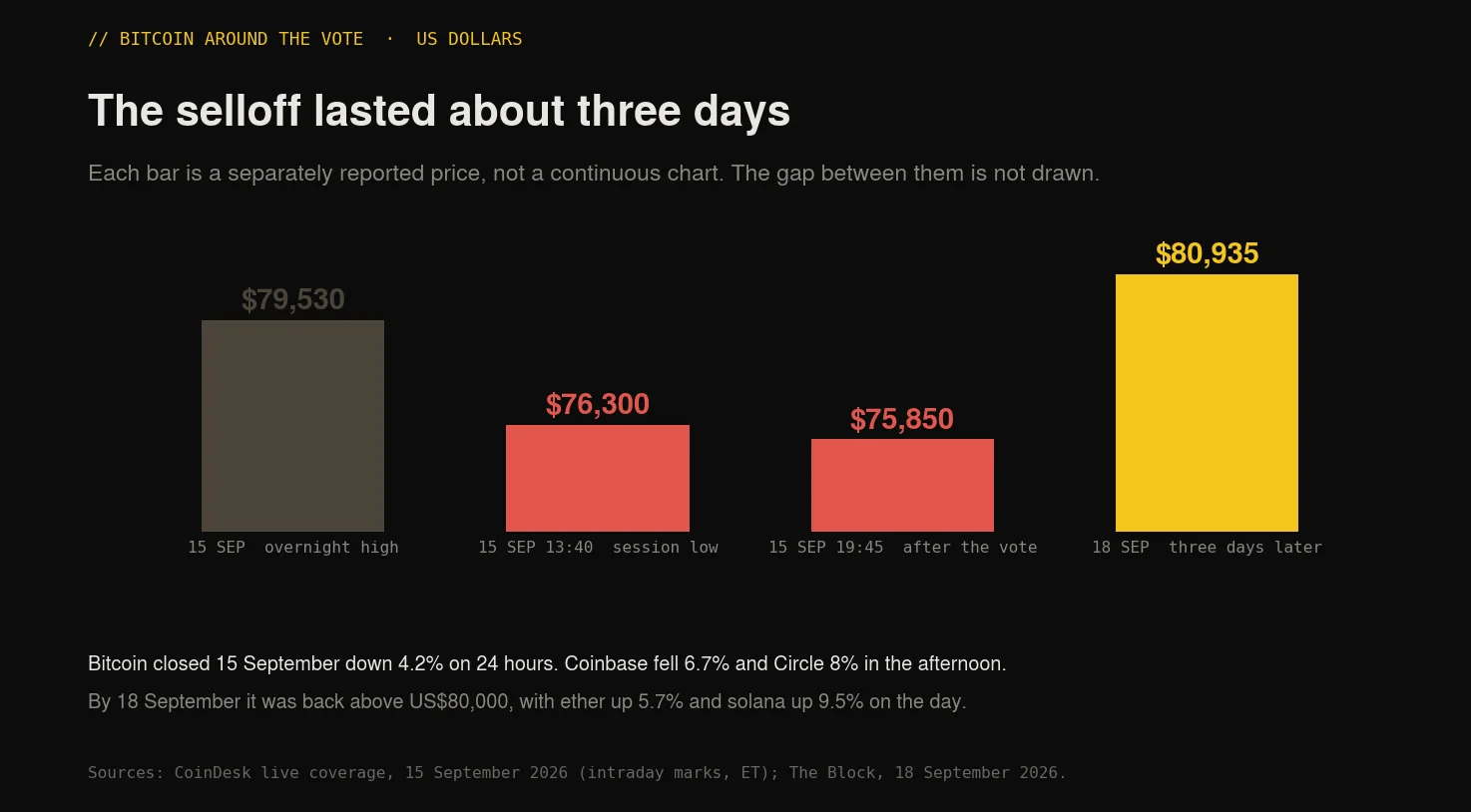
Bitcoin around the failed cloture vote. Each bar is a separately reported price, not a continuous series.
Dan Morehead of Pantera Capital gave the explanation on the day of the recovery. The industry does not need Congress, he argued, because the SEC and the CFTC are enacting all of the things that would have been in the bill anyway.
The agencies moved instead
He was describing something that had already happened.
On 18 September, three days after the vote, the CFTC filed two rulemakings, Regulation Crypto Asset Transactions and Regulation Crypto Asset Markets, with the Office of Information and Regulatory Affairs at the White House. CFTC chair Mike Selig had said the agency would use its existing authorities to begin establishing a regime for crypto asset markets if the legislation stalled. After the vote he posted that the CFTC was locked in and ready to ship its rules. In the same week the SEC issued an innovation exemption covering onchain tokenised stock trading.
This is not a free substitute for a statute, and it is worth being precise about why.
The timeline is long. OIRA review has no fixed deadline. After it, the proposal returns to the CFTC for a vote, then a public comment period, then another vote before anything takes effect.
The legal footing is weaker. A rule written under existing authority can be unwound by a later administration or narrowed by a court in a way that an act of Congress cannot.
The scope is unclear. Which assets are covered, what an exchange would have to qualify as, and how far the CFTC's jurisdiction actually reaches are all still open.
Tillis's motion to reconsider theoretically allows another Senate vote. John Thune is unlikely to spend floor time on it without bipartisan commitments that do not currently exist.
What Asia already has
Here is the part the coverage keeps missing. This was a United States failure for United States reasons. It is not evidence that digital asset regulation is inherently hard to write.
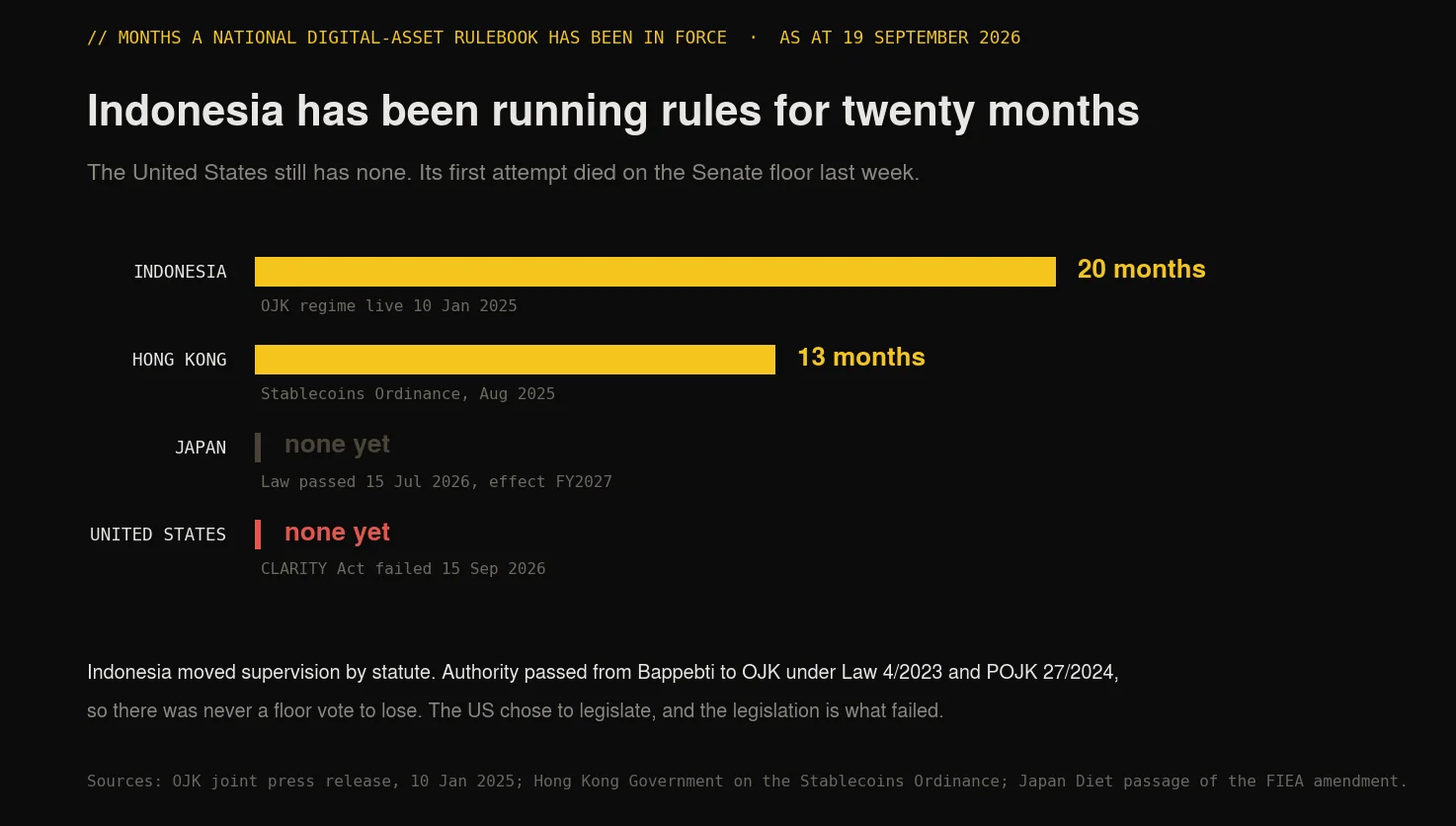
Months a national digital asset rulebook has been in force, as at 19 September 2026.
Indonesia never had this fight, because Indonesia never needed a floor vote. Supervision of digital financial assets moved from Bappebti, the commodity futures regulator under the trade ministry, to OJK, the financial services authority, on 10 January 2025. The legal basis was already in place: Law 4 of 2023 on the development and strengthening of the financial sector, implemented through Government Regulation 49 of 2024, OJK Regulation 27 of 2024 and circular SEOJK 20 of 2024. The handover was administrative. The rulebook has been running for twenty months.
Hong Kong's Stablecoins Ordinance has been in force since August 2025. The HKMA received 36 applications in the first licensing window and granted two issuer licences in April 2026, to HSBC and to Anchorpoint Financial, a joint venture of Standard Chartered, HKT and Animoca Brands.
Japan's Diet passed the FIEA amendment on 15 July 2026, moving roughly 105 crypto assets out of the Payment Services Act and into securities law with insider trading prohibitions attached. Full effect is targeted for fiscal 2027.
Three jurisdictions, three different routes, none of them blocked by an ethics dispute. This is the backdrop every serious blockchain event in Asia is now working against, Web3 Week Asia in Jakarta included.
What this means if you are building in Indonesia
The practical read is short.
If your plan involved waiting for American regulatory clarity before structuring a token, launching an exchange product or taking institutional capital, there is now no US statutory answer before 2027 at the earliest, and quite possibly not until the midterms change the arithmetic. What exists instead is agency rulemaking that will take months and can be reversed.
What you do have is an Indonesian answer, and it has been sitting there for twenty months. OJK licenses the intermediaries. POJK 27/2024 sets the terms. And the market underneath it is not small.
Indonesia had 22.93 million registered crypto accounts as of July 2026. Transaction value that month was Rp20.52 trillion, down 28.2 per cent from Rp28.58 trillion in June, which was itself up 24.2 per cent on May. The volume is volatile and worth naming honestly rather than hiding. The user base is not volatile. It has grown every month.
The binding constraint on building here stopped being regulatory uncertainty some time ago. It is liquidity, product and distribution. Those are solved in rooms, not in legislatures, which is why the calendar of Indonesia crypto events has become more useful to a founder than the US legislative calendar.
That is where an Indonesia crypto event stops being a networking line item and starts being the fastest way to get an answer.
Web3 Week Asia: the Indonesia crypto event where this gets settled
Web3 Week Asia runs on 11-12 November 2026 in Jakarta, Indonesia. It is a two-day blockchain event built around the people who actually decide things in this market: the regulators who wrote POJK 27/2024, the licensed exchanges operating under it, the funds allocating into Southeast Asia, and the founders shipping products to 22.93 million Indonesian accounts.
The 2025 edition drew more than 5,000 participants, over 100 speakers and more than 200 companies. The 2026 edition returns to Jakarta on 11-12 November.
The reason it matters more this year than last is the thing this article has been about. For most of 2025 and 2026, the standing advice to anyone building in Asia was to watch Washington, because a US market structure statute would set the template everyone else copied. That template did not arrive, and on current evidence it will not arrive before 2027.
What did arrive is a working Indonesian framework, a Hong Kong stablecoin regime, a Japanese securities-law reclassification, and a US regulatory apparatus improvising under old authorities. The centre of gravity for practical answers moved, and it moved towards this region. A blockchain event in Jakarta in November 2026 is now where you find out what the rules are, rather than where you speculate about what they might become.
Frequently asked questions
When and where is Web3 Week Asia 2026?
Web3 Week Asia takes place on 11-12 November 2026 in Jakarta, Indonesia. It is a two-day crypto and blockchain event covering regulation, infrastructure, trading and venture investment across Southeast Asia.
Why did the CLARITY Act fail?
It failed a Senate cloture vote 49 to 50 on 15 September 2026, eleven votes short of the 60 needed. Democrats withheld support over ethics provisions they considered unenforceable, in the context of the president's disclosed US$1.4 billion in crypto income for 2025. It was not a dispute about market structure itself.
Does Indonesia have crypto regulation?
Yes. Supervision of digital financial assets moved from Bappebti to OJK, the financial services authority, on 10 January 2025, under Law 4 of 2023 and OJK Regulation 27 of 2024. Indonesia has had a functioning national rulebook for twenty months, which is twenty months longer than the United States.
What happens to US crypto regulation now?
The CFTC filed two crypto market rulemakings with the White House on 18 September 2026 and the SEC issued an innovation exemption for tokenised stock trading. Both are agency rules made under existing authority, so they take months to finalise and can be reversed by a later administration.
Sources
The transfer of digital financial asset supervision from Bappebti to OJK, including the legal basis and the transaction figures at handover, joint press release dated 10 January 2025: https://ojk.go.id/en/berita-dan-kegiatan/siaran-pers/Pages/Bappebti-Transfers-Regulation-and-Supervision-Duties-on-Digital-Financial-Assets-Crypto-Assets-and-Derivatives-to-OJK-BI.aspx
How Indonesia's crypto market is structured, and who regulates what: our guide at https://www.w3w.asia/articles/indonesia-crypto-market-2026-jakarta-web3-hub
Vote details and bill provisions are from the Jones Day client alert of September 2026 and reporting by Forbes and The Crypto Times. The legislative timeline is from the Latham and Watkins US crypto policy tracker. Disclosure figures are from the Office of Government Ethics filing released 30 June 2026 as reported by ABC News and Time. Industry quotes and the Fairshake figure are from Bloomberg's reporting of 18 September 2026 and FactCheck.org. Market prices are from CoinDesk's live coverage of 15 September and The Block of 18 September. CFTC filing details are from The Block and CoinDesk of 18 September. Indonesian market data is from OJK as reported by ANTARA, CNBC Indonesia and Bareksa.
Methodology: the cloture tally of 49 to 50 is confirmed by two independent reports. The party split is derived from those reports and the 53-47 composition of the Senate, and is marked as derived on the chart. Several outlets dated the vote 16 September; the Senate calendar, the Jones Day alert and the contemporaneous live coverage all place it on Tuesday 15 September, which is the date used here. The internal breakdown of the 1.4 billion dollar figure differs between outlets and is therefore described but not charted.
This article is for information only and is not investment advice.