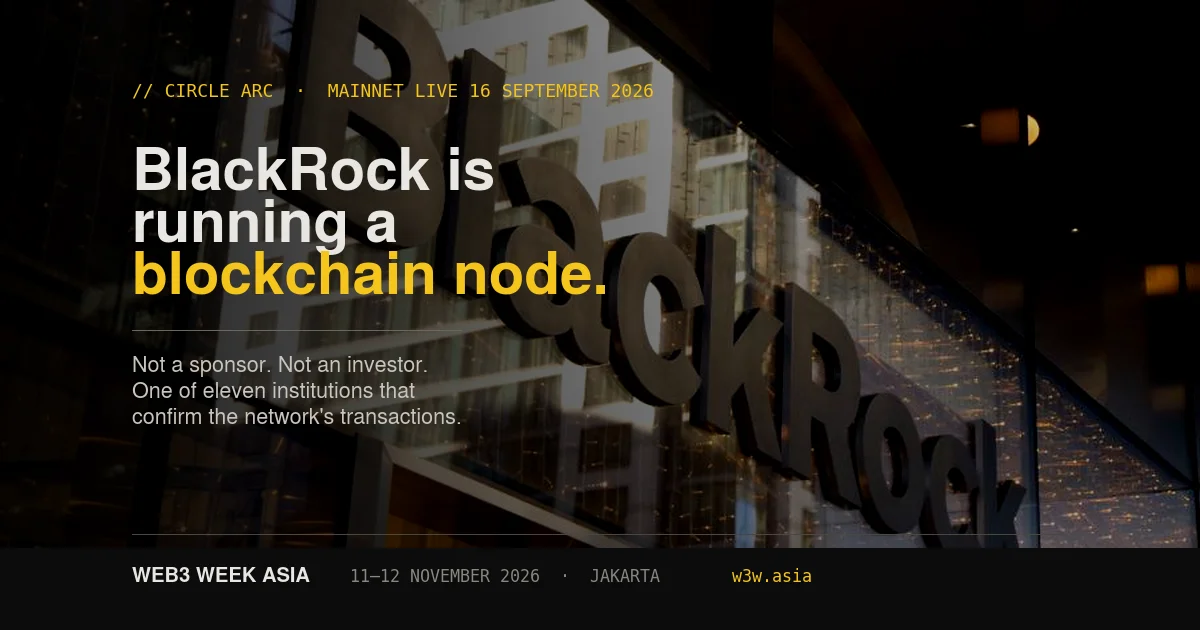
On 16 September 2026, Circle switched on a blockchain called Arc. The technology is not the story.
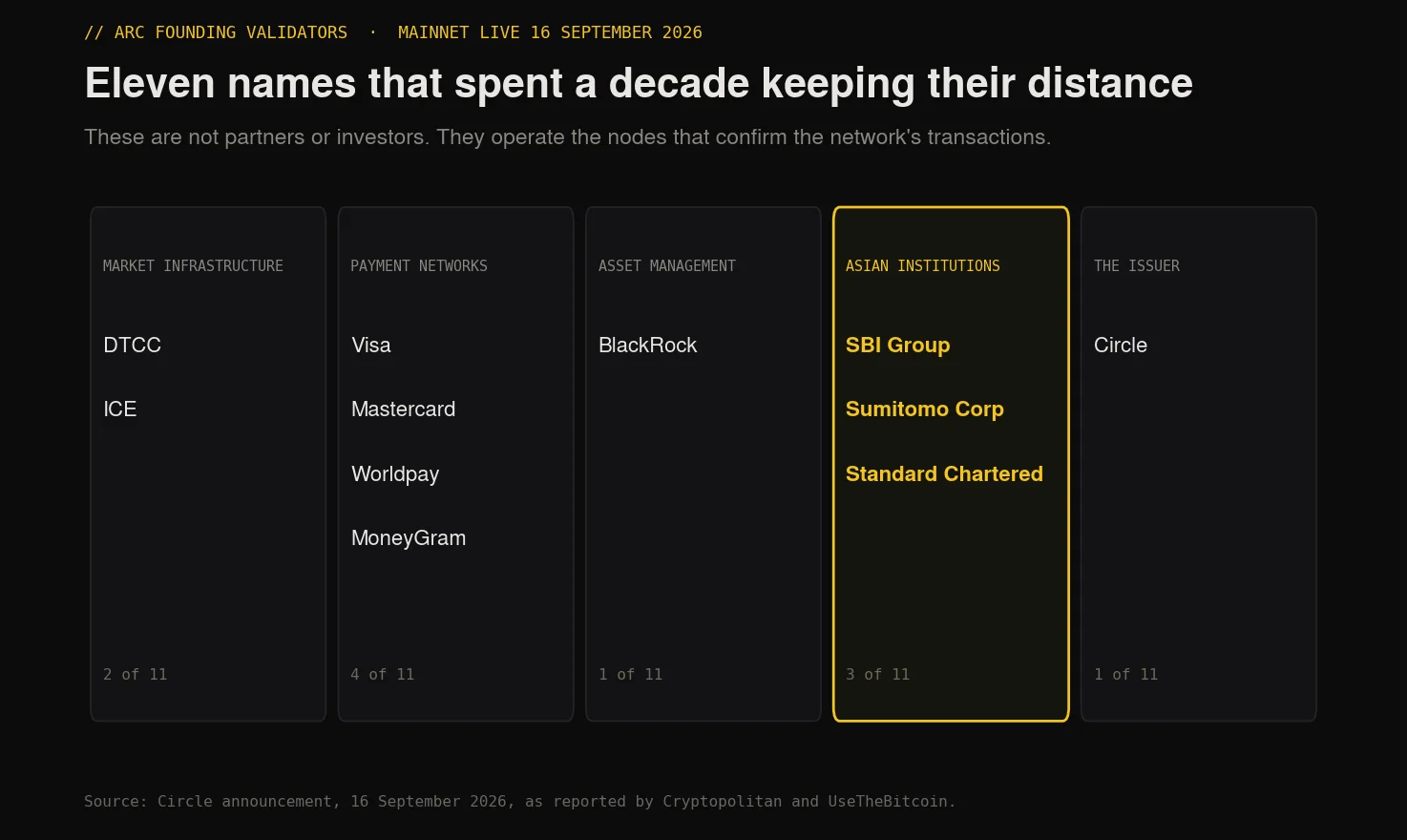
The story is who is running it. BlackRock. Visa. Mastercard. The Depository Trust and Clearing Corporation, which settles most of the US securities market. Intercontinental Exchange, which owns the New York Stock Exchange.
These are not sponsors or investors. They are validators, which means they operate the machines that confirm the network's transactions. The institutions that spent a decade explaining why they kept crypto at arm's length are now, in the most literal sense, part of the plumbing.
Key Facts
What launched: Arc, an EVM-compatible Layer 1 blockchain built by Circle, the company behind the USDC stablecoin. Mainnet went live on 16 September 2026.
Who validates it: eleven founding validators - BlackRock, Circle, DTCC, ICE, Mastercard, MoneyGram, SBI Group, Standard Chartered, Sumitomo Corporation, Visa and Worldpay.
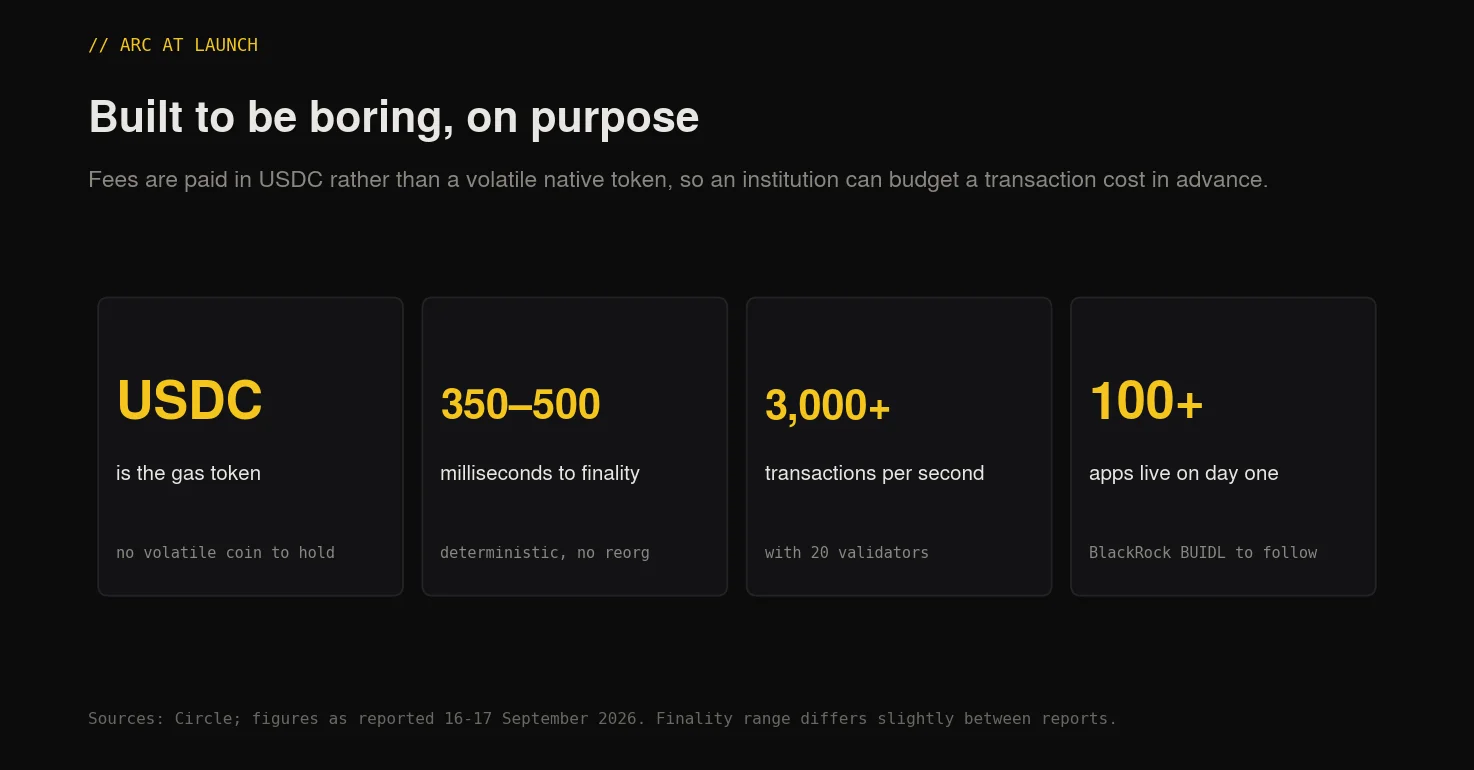
The design choice that matters: transaction fees are paid in USDC, not in a volatile native token.
Speed: deterministic finality reported at roughly 350 to 500 milliseconds, with throughput above 3,000 transactions per second at twenty validators.
Day one: more than 100 applications and institutional builders launched on it. BlackRock's BUIDL fund, at about 2.87 billion dollars, is expected to deploy.
How Circle frames it: chief executive Jeremy Allaire called Arc "the single most significant launch in Circle's history since USDC itself."
Why paying gas in USDC is the whole point
Every public blockchain charges a fee to process a transaction, and almost all of them require that fee to be paid in their own token. To use Ethereum you need ether. To use Solana you need SOL.
For a trading desk that is a minor inconvenience. For a bank it is a compliance problem and an accounting problem at the same time. You cannot tell a treasury team that the cost of settling a payment will be whatever a volatile asset happens to be worth at the moment the transaction clears, and you cannot easily explain to a risk committee why the firm is holding a speculative token at all.
Allaire put it plainly: forcing institutions to hold a chain's token is like "making Netflix buy Amazon shares to pay its AWS bill."
Arc charges in USDC. A treasury team can price a transaction in advance, in dollars, and hold nothing speculative to do it. That single decision is what makes the validator list possible.
The detail almost every outlet skipped
Read the validator list again and count the Asian institutions.
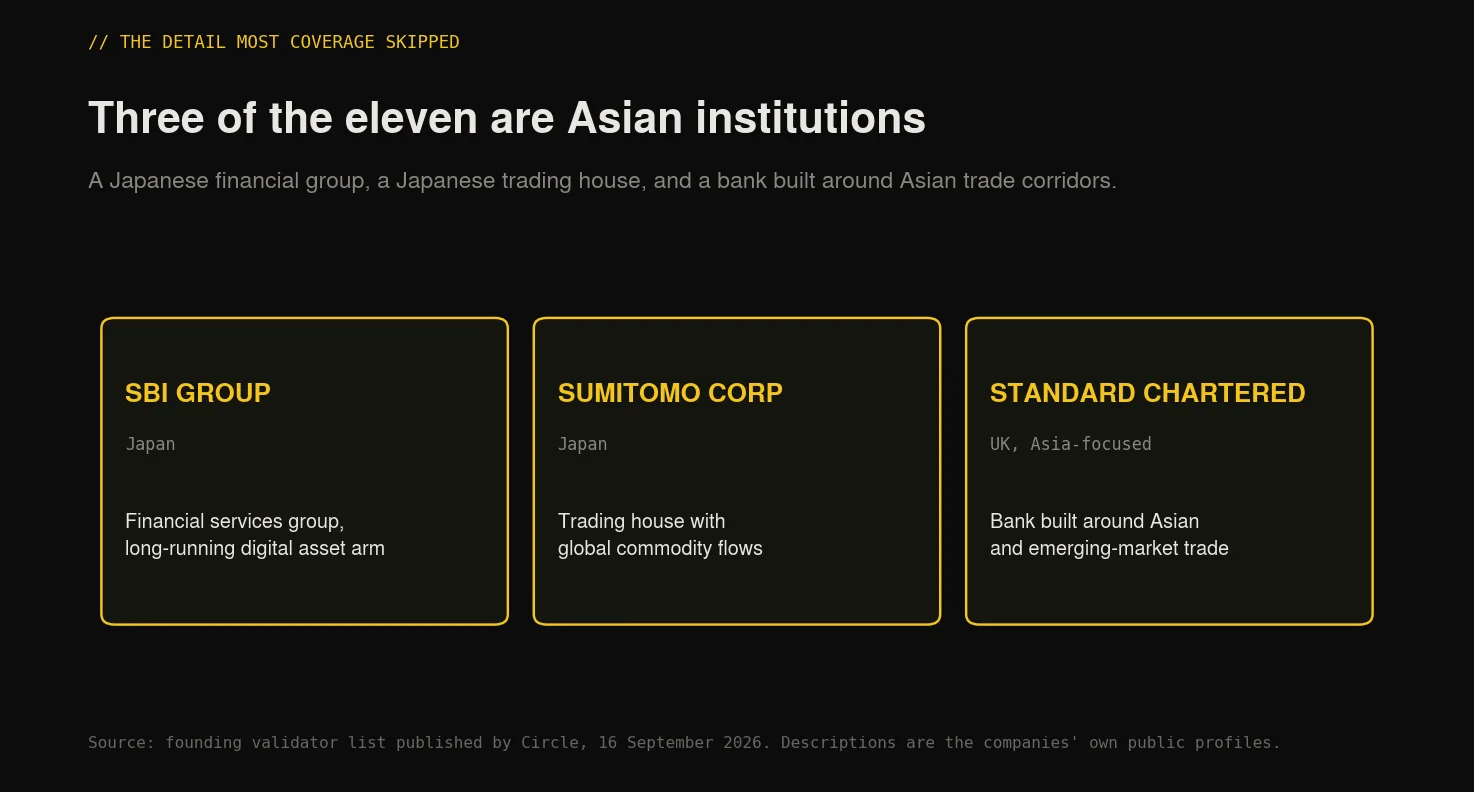
SBI Group, the Japanese financial services group with one of the longest-running digital asset operations of any traditional financial firm. Sumitomo Corporation, a Japanese trading house whose business is moving physical goods and the money that follows them. Standard Chartered, a bank whose entire franchise is built around trade corridors across Asia, the Middle East and Africa.
Three of eleven. Not one token inclusion, and not a coincidence.
The reason is structural. Cross-border settlement is a bigger problem in Asia than in the United States, because more of the economic activity crosses a border and more of it crosses a currency. A domestic American payment has one currency and one banking system. A payment from a Japanese trading house to an Indonesian supplier has two of each, several correspondent banks, and a settlement window measured in days.
That is the problem stablecoin rails are genuinely good at. It is also why the institutions most motivated to sit on this network are the ones whose business is trade, not the ones whose business is securities.
The honest counterweight
Three things belong next to the headline.
A validator set of eleven named institutions is not decentralisation. It is a consortium. That is a reasonable design for regulated finance and a poor fit for anyone who values censorship resistance. Arc is not trying to be Bitcoin, and pretending otherwise helps nobody.
Day one is not adoption. More than a hundred applications launching is a real signal of preparation, not of volume. The number worth watching in three months is settled value, not application count.
Circle benefits most. USDC as the gas token means every transaction on Arc consumes the product Circle issues. The design is coherent and it is also self-interested. Both can be true.
What this means from where we sit
Indonesia is exactly the kind of market this infrastructure is aimed at, and exactly the kind of market that tends to be the last to be consulted about it.
The country's crypto activity is overwhelmingly domestic retail, denominated in rupiah, supervised by OJK since January 2025. Stablecoin rails built for institutional cross-border settlement do not touch that directly. What they touch is the layer above it: the trade finance, remittance and corporate treasury flows that move between Indonesia and the rest of Asia, and which currently cost days and basis points at every hop.
The practical question for Indonesian firms is not whether to use Arc. It is whether the counterparties they trade with are about to start, and what that does to expectations about settlement speed. When a Japanese buyer can settle in under a second, a supplier still working on a two-day cycle is negotiating from a weaker position.
That question is not answered by reading announcements. It is answered by talking to the exchanges, banks and regulators who will actually implement it or refuse to. In Indonesia those people are in one room at Web3 Week Asia, on 11-12 November in Jakarta, on the Indonesia Crypto Outlook track.
Frequently Asked Questions
What is Circle's Arc blockchain?
An EVM-compatible Layer 1 blockchain built by Circle, the issuer of USDC. It went live on mainnet on 16 September 2026 and is designed for institutional payments and settlement rather than general-purpose applications.
Who are Arc's validators?
Eleven founding validators: BlackRock, Circle, DTCC, ICE, Mastercard, MoneyGram, SBI Group, Standard Chartered, Sumitomo Corporation, Visa and Worldpay.
Why does Arc use USDC for gas fees instead of its own token?
So that institutions can price a transaction in dollars in advance and avoid holding a volatile asset purely to pay fees. Circle's chief executive compared the usual arrangement to making a company buy shares in its cloud provider in order to pay its hosting bill.
Is Arc decentralised?
Not in the sense Bitcoin or Ethereum are. Eleven named institutions run the validator set, which is a consortium model. That is a deliberate trade-off in favour of regulatory clarity and predictable performance.
Why does this matter in Southeast Asia?
Because cross-border settlement is a larger share of economic activity here than in the United States, and three of the eleven founding validators are Asian institutions whose business is trade finance and cross-border flows.
The bottom line
The interesting thing about Arc is not that a stablecoin company launched a blockchain. It is that eleven of the most conservative institutions in global finance agreed to operate the nodes.
For a decade the argument was that traditional finance would eventually use this technology while keeping a careful distance from it. Running validator infrastructure is not a careful distance.
And the composition of that list says something about where the demand actually is. The problem stablecoin rails solve best is moving money across borders and currencies quickly, which is a bigger problem in Asia than in the market where most of the coverage is written. Three of eleven is a small number that points at something large.
Sources
Circle Arc mainnet launch, founding validators and specifications, as reported 16 September 2026: https://www.cryptopolitan.com/circle-arc-mainnet-launch/
Background on how Indonesia's crypto market is structured: our guide at https://www.w3w.asia/articles/indonesia-crypto-market-2026-jakarta-web3-hub
Additional figures are drawn from UseTheBitcoin's reporting of 16 September 2026 on validator composition, day-one application count and the BUIDL fund.
Methodology: the validator list, gas-token design, finality and throughput figures are as published by Circle and reported by two independent outlets on 16 and 17 September 2026. Reported finality figures differ slightly between sources, so a range is given rather than a single number. Descriptions of the three Asian validators are drawn from those companies' own public profiles. Nothing in this article has been verified against on-chain data, which did not exist at the time of writing.
This article is for information only and is not investment advice.