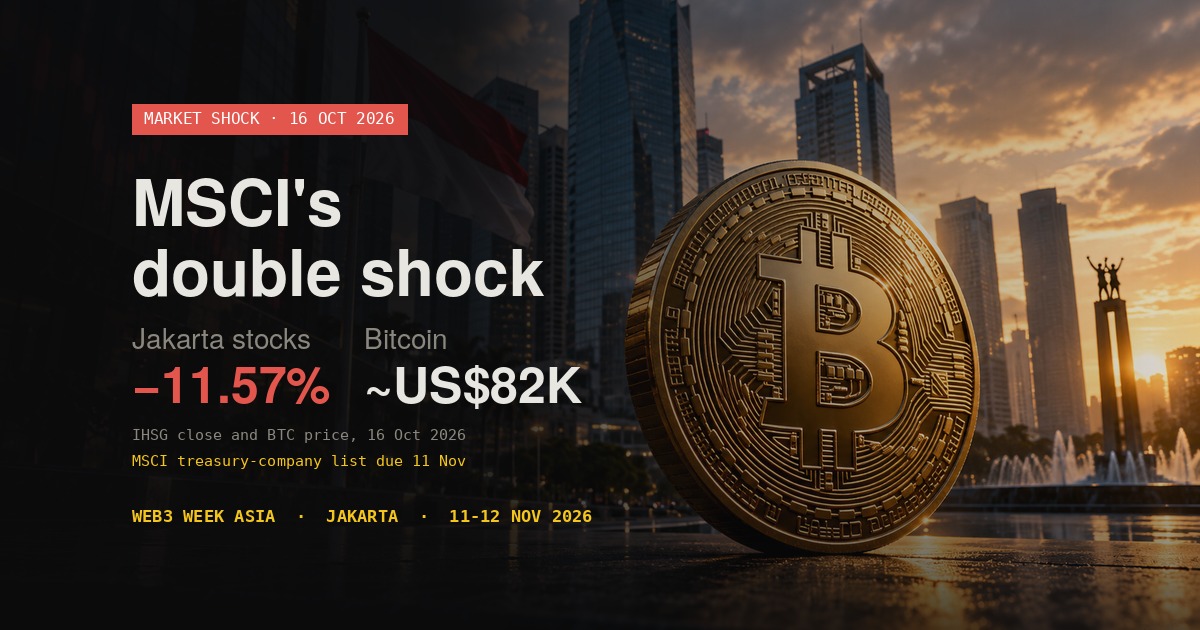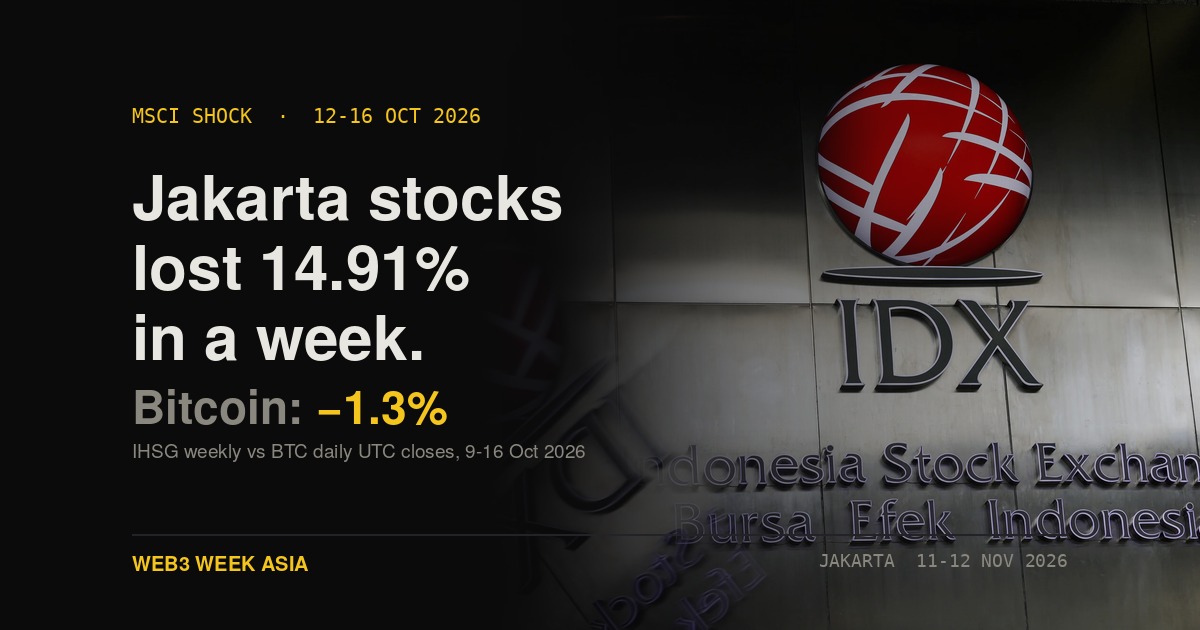
On Friday 16 October 2026 the Jakarta Composite Index (IHSG) closed at 5,185.105, down 11.57% in a single session, after MSCI proposed moving Indonesia out of its Emerging Markets classification. Over the week of 12-16 October the index lost 14.91%, according to Indonesia Stock Exchange (BEI) data reported by Republika and Okezone.
Over the same week bitcoin fell about 1.3%. In Seoul, the Kospi lost 14.46% in its worst week since October 2008. Two Asian stock markets had their worst weeks in years, and the largest crypto asset barely moved. That contrast is the detail most coverage of the MSCI story leaves out, and it matters for anyone heading to Web3 Week Asia on 11-12 November 2026 in Jakarta, where regulation and market structure are on the agenda.
The trigger. On 15 October 2026 MSCI opened a consultation on reclassifying the MSCI Indonesia Indexes from Emerging Market to Standalone Market status, citing opaque shareholding structures and suspected coordinated trading.
The timeline. MSCI accepts feedback until 30 April 2027 and will announce a decision on or before 30 June 2027. Until then it has frozen additions to the MSCI Indonesia IMI and increases in foreign inclusion factors.
Jakarta. IHSG lost 14.91% over 12-16 October and 11.57% on 16 October alone. BEI halted trading for 30 minutes at 08:58 WIB that morning after an 8% drop at the open.
Seoul. The Kospi lost 14.46% over the same week, according to Benzinga and TokenPost, including a 7.57% fall on 15 October.
Bitcoin. Daily UTC closes from Investing.com and CoinGecko both show bitcoin about 1.3% lower from 9 October to 16 October, at roughly US$81,500.
What MSCI actually proposed
MSCI did not downgrade Indonesia on 15 October. It launched a consultation and said it "expects to proceed with the proposed reclassification unless the consultation identifies clear evidence" of material improvement in governance and market functioning.
Standalone status matters because it removes a market from the MSCI Emerging Markets index that many global funds track. MSCI said announced reforms, including a roadmap to a 15% minimum free float, have not yet produced "consistent, measurable progress".
The selling was not new. BEI daily statistics, reported by Investortrust, show foreign investors net sold Rp3.34 trillion on 16 October and Rp88.19 trillion since the start of 2026. Reuters, carried by The Star, put foreign net selling for the year at US$4.7 billion. Why it matters: the MSCI proposal sped up an outflow that was already running, rather than starting one.
The scale of the week in Jakarta
Market capitalisation on BEI fell 14.43% in the week, from Rp10,701 trillion to Rp9,157 trillion, a loss of Rp1,544 trillion, according to Okezone and Beritasatu. Okezone and Liputan6 both described the daily drop as the steepest since 1998.
Investortrust and Liputan6 put the IHSG's loss since the start of 2026 at 40.04%. Reuters gave "more than 30%" in a report published during the 16 October session, before the full Friday fall.
The rupiah also weakened. Bisnis.com reported a 16 October close of Rp18,025 per US dollar (down 0.49%) and CNN Indonesia Rp18,038 (down 0.56%), so the rupiah closed a little above Rp18,000.
Seoul's parallel crash, and where Korean money went
The Korean sell-off had different causes: Seoul Economic Daily and Startup Fortune link it to doubts about AI investment returns and a claimed DRAM advance by China's CXMT, which hit Samsung Electronics and SK hynix. The Kospi fell for seven straight sessions, from 7,003.74 on 2 October to 5,554.22 on 15 October, a drop of about 20.7%, before rebounding 2.05% on 16 October.
The flow data is where the story behind the headline sits. SBS reported on 17 October that Korean retail investors had bought a net US$3.5 billion of US stocks in October up to that point and US$2.6 billion of a triple-leveraged US semiconductor ETF in a single week. Forced liquidations of margin positions on Korean stocks reached 298.1 billion won between 6 and 15 October.
On crypto, the evidence is thinner. TokenPost reported that Upbit's 24-hour volume rose 78.3% to US$1.21 billion in the period ending 15 October. That single-source figure does not show money moving from stocks into crypto. Why it matters: the clearest recorded flow was retail money staying in equities and adding leverage, not a rotation into digital assets.
The honest counterweight
Bitcoin's calm week followed a weak year. Bitcoin started 2026 at US$87,000 to US$88,242, according to Bitcoin Magazine and CNBC, so at about US$81,500 it was down roughly 6% to 8% for 2026 as of 16 October.
One week does not establish decoupling. CoinDesk reported a negative rolling correlation of -0.41 between bitcoin and the Kospi, but its own article gives two different lookback windows for that figure. No study cited here shows that bitcoin reliably protects investors during Asian equity crashes.
Crypto and stock accounts are not comparable counts. OJK reported 23.21 million crypto consumer accounts as of August 2026, while BEI reported 31.9 million capital market investors (SID) as of September. Accounts can be duplicated across exchanges and the SID count includes funds and bonds, so the overlap between the two groups is not known.
What the MSCI shock means for Indonesia crypto
The same regulator supervises both markets. OJK has overseen digital financial assets, including crypto, since 10 January 2025 under Government Regulation 49/2024, and the IAKD unit reported Rp23.16 trillion of crypto transactions in August 2026, up 12.87% from July, according to Investortrust and Media Indonesia. CNN Indonesia reported that OJK chair Friderica Widyasari Dewi met BEI after the drop and described the response as the largest reform in the history of the Indonesian capital market.
This matters for crypto because the issues MSCI named, ownership transparency and suspected coordinated trading, are the same ones regulators examine in crypto markets. Indonesia's licensed crypto structure, with two exchanges, two clearing houses and two custodians supervised by OJK as of September 2026, was built partly to answer those questions. Whether it does so better than the stock market is not established.
The data does not show Indonesian investors moving from stocks to crypto during the sell-off. OJK's monthly crypto figures for October will be the first official test, and they are not yet published.
Web3 Week Asia 2026: blockchain event in Jakarta, 11-12 November
Web3 Week Asia takes place on 11-12 November 2026 in Jakarta, at the Grand Ballroom at Kuningan City according to the official site. Its four tracks are Investor Meetups, Alpha Callers, Web3 Entrepreneur and Indonesia Crypto Outlook 2026; the last covers the market-structure and foreign-capital questions the MSCI proposal has raised.
The organisers say the 2025 edition drew more than 5,000 participants, over 100 speakers and more than 200 companies from more than 10 countries. The 2026 speaker line-up is still to be announced. Passes are available as Student, General and VIP.
Frequently asked questions
When and where is Web3 Week Asia 2026?
Web3 Week Asia 2026 takes place on 11-12 November 2026 in Jakarta, Indonesia, a two-day crypto and blockchain event covering markets, regulation, infrastructure and venture investment across Southeast Asia.
Has MSCI downgraded Indonesia?
No. On 15 October 2026 MSCI opened a consultation on moving Indonesia to Standalone Market status. Feedback closes on 30 April 2027 and the decision is due by 30 June 2027.
How much did the Jakarta stock market fall?
The IHSG fell 11.57% on 16 October 2026 to 5,185.105, and 14.91% over 12-16 October, according to BEI data.
What did bitcoin do during the same week?
Bitcoin closed about 1.3% lower from 9 to 16 October 2026, at roughly US$81,500, according to Investing.com and CoinGecko.
Did Indonesian investors move from stocks into crypto?
No published data shows that. OJK's crypto figures for October 2026 are not yet out.
Sources
MSCI consultation on reclassifying Indonesia, 15 October 2026: https://ir.msci.com/news-releases/news-release-details/msci-launches-consultation-proposal-reclassify-indonesia
Earlier W3W analysis of the Indonesian crypto market: https://www.w3w.asia/articles/indonesia-crypto-market-2026-jakarta-web3-hub
MSCI proposal, timeline and interim measures: MSCI press release, 15 October 2026, and Reuters via The Star, 16 October 2026. IHSG daily and weekly figures, market capitalisation and foreign net selling: BEI data as reported by Republika, Okezone, CNN Indonesia, Investortrust and Liputan6, 16-17 October 2026. Rupiah closes: Bisnis.com and CNN Indonesia, 16 October 2026. Kospi figures: Benzinga and TokenPost (weekly), Seoul Economic Daily and Startup Fortune (daily), 16-18 October 2026. Korean retail flows and margin liquidations: SBS, 17 October 2026. Upbit volume: TokenPost, 15 October 2026. Bitcoin prices: Investing.com and CoinGecko daily closes; start-of-year price from Bitcoin Magazine (31 December 2025) and CNBC (1 January 2026). Bitcoin-Kospi correlation: CoinDesk, 13 October 2026. Indonesian crypto data: OJK via Investortrust and Media Indonesia, 5-6 October 2026; capital market investor count: BEI via Antara and Liputan6.
Methodology: Bitcoin's weekly change compares the 9 October and 16 October 2026 UTC daily closes on Investing.com (US$82,623.6 to US$81,587.4, minus 1.25%) and CoinGecko (US$82,564 to US$81,524, minus 1.26%). Its change for 2026 compares the 16 October closes with the start-of-year range of US$87,000 to US$88,242, giving minus 6.2% to minus 7.6%. The Kospi seven-session fall is computed from closes of 7,003.74 and 5,554.22. Rupiah closes differ between Bisnis.com and CNN Indonesia and are given as a range. The intraday bitcoin low differs by venue (about US$79,800 to US$80,200) and is not used as a headline figure. Upbit volume, Korean retail flows and the correlation figure are single-source and attributed. Crypto and stock investor counts are not combined or compared as a ratio.
This article is for information only and is not investment advice