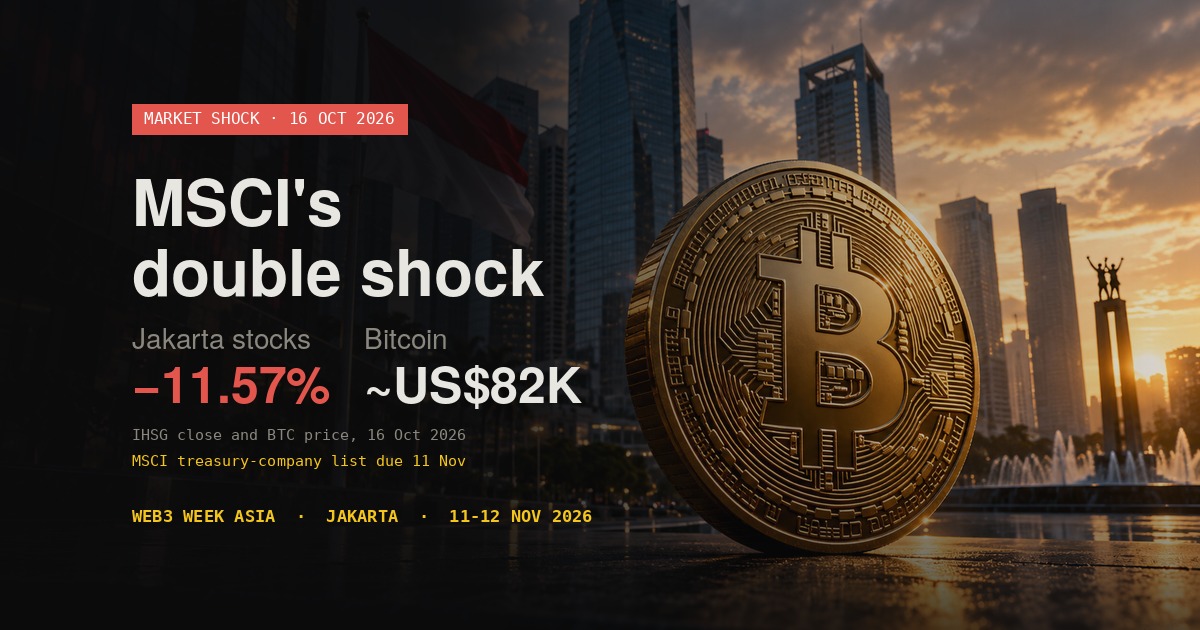
On Friday 16 October 2026, the Jakarta Composite Index closed at 5,185.11, down 11.57% in a single session, its deepest one-day fall since 1998. Bitcoin barely moved. It was quoted at about US$82,200 at 07:00 WIB and about US$82,700 at 18:22 WIB, after the Jakarta close, when Yahoo Finance had it 0.7% above Thursday's open. One index provider, MSCI, was behind the stock move, and within the same 24 hours it also finalised a rule aimed at listed companies that hold bitcoin.
That pairing is the detail most coverage skipped. On Thursday 15 October in New York, MSCI announced two decisions: one questions Indonesia's emerging-market status, the other decides whether bitcoin treasury companies such as Strategy and Japan's Metaplanet stay in its global indexes. The second decision produces a list of affected companies on 11 November, the opening day of Web3 Week Asia, which runs 11-12 November 2026 in Jakarta.
Here is what is confirmed and what is still an estimate.
The Indonesia proposal. MSCI opened a consultation on moving the MSCI Indonesia Indexes from Emerging Market to Standalone Market status, skipping Frontier status, according to MSCI's release dated 15 October 2026.
The timeline. Feedback closes on 30 April 2027 and MSCI will decide on or before 30 June 2027, per the same release and The Jakarta Post.
The market reaction. The index fell 8.01% at the open, triggering a trading halt, and closed 11.57% lower with 812 stocks down, according to Bisnis.com; detik and Kompas reported the same close.
The rupiah. The currency closed at about Rp18,025 to Rp18,027 per US dollar on 16 October, the weakest in Asia that day, according to Bisnis.com and Kontan.
The crypto rule. MSCI finalised its non-operating company rules on 15 October; changes apply after the close on 30 November 2026, according to The Block and The Crypto Times.
What MSCI actually said about Indonesia
MSCI's wording is blunt. It said Indonesia's continued classification as an Emerging Market is "no longer appropriate" and that it expects to proceed unless the consultation finds clear evidence of material improvement in market governance and functioning. The reasons given are opaque shareholdings, suspected coordinated trading and a lack of meaningful enforcement.
In June 2026, MSCI said it would consider a consultation if progress was not visible by the November 2026 index review, as reported by The Edge Singapore and Indonesia Business Post. Reforms announced since then include disclosure of shareholders above 1% and a roadmap to a 15% minimum free float; MSCI said investors had not seen consistent evidence that they work. Its freeze on index increases for Indonesian stocks stays until further notice.
Why it matters: a Standalone label removes a market from the emerging-market benchmarks that, according to Reuters, more than US$1.8 trillion tracks.
How big the money question is
Estimates differ, and none is official. Reuters cited JPMorgan at US$4.8 billion of passive outflows and UBS warning that active investors could pull another US$15 billion. Bloomberg, as published by the Taipei Times, cited Mirae Asset Sekuritas Indonesia at about US$3 billion and Citigroup at "mid-single-digit billions". Reuters put the value wiped off Indonesian equities on 16 October at about US$65 billion.
Indonesia's weight in the MSCI Emerging Markets Index is already small: about 0.46% according to JPMorgan figures cited by Reuters, and about 0.4% according to Bloomberg. Both point to under 0.5%.
Why it matters: a small weight limits passive selling in dollar terms, yet the 16 October fall was far larger than index arithmetic alone would suggest.
The bitcoin treasury rule, and why 11 November matters
MSCI's second decision covers its Global Investable Market Indexes. A company is first screened for whether its balance sheet holds substantial operating assets, then tested on five financial ratios; failing four or more makes it ineligible, according to The Crypto Times and Crypto Briefing. Current members are removed only if they fail in both of their two most recent annual filing periods.
A May 2026 MSCI simulation flagged Strategy, Metaplanet and Yellow Cake, a London-listed uranium holder. Strategy held 848,250 BTC as of 12 October 2026, according to The Block and The Crypto Times. Metaplanet held 44,000 BTC as of 30 September 2026, according to The Crypto Times and Odaily.
JPMorgan analysts estimated in late 2025 that removing Strategy could cause about US$2.8 billion of passive outflows. That figure refers to an earlier proposal and is not a new projection.
Why it matters: removal would not require either company to sell bitcoin. Any selling would be index funds selling shares, so any effect on bitcoin would be indirect.
The honest counterweight
No crypto inflow is shown. There is no published data showing money moved from Indonesian stocks into crypto on 16 October. Two prices moving differently is not evidence of a flow.
The downgrade is not final. MSCI's decision is due by 30 June 2027. MSCI said it expects to proceed, but evidence of working reforms could change that.
Outflow figures are forecasts. The estimates mix passive and active money from different banks and methods, and should not be added up.
What it means for Indonesia crypto users
The overlooked link is the regulator. OJK supervises Indonesia's capital market and, since January 2025, digital asset trading, after taking over crypto oversight from Bappebti, as reported by IDN Financials and law firm SSEK. MSCI's criticism centres on enforcement and transparency. The same agency's credibility is now under scrutiny, although MSCI's decision applies only to equities.
According to Bloomberg, OJK said it is reviewing MSCI's assessment and is committed to stronger enforcement. The Indonesia Stock Exchange said it would ask MSCI to clarify the basis of its announcement, according to Bisnis.com.
The currency effect is more direct: a weaker rupiah raises the rupiah value of the same bitcoin. The rupiah lost 0.49% on 16 October, according to Bisnis.com. Bank Indonesia's board meets on 20-21 October 2026, per its published calendar, and Reuters reported that some analysts have raised the possibility of a rate hike.
Web3 Week Asia 2026: blockchain event in Jakarta, 11-12 November
Web3 Week Asia takes place on 11-12 November 2026 in Jakarta, at the Grand Ballroom at Kuningan City according to the official site. Its four tracks are Investor Meetups, Alpha Callers, Web3 Entrepreneur and Indonesia Crypto Outlook 2026.
The timing is unusual. MSCI's list of companies affected by the non-operating rule is expected on 11 November, the first day of the event, and the Indonesia consultation will be live throughout. The event covers markets and regulation across Southeast Asia, and its Indonesia Crypto Outlook 2026 track is where questions about Indonesian market structure and investor confidence fit.
The 2025 edition drew more than 5,000 participants and over 100 speakers, according to the organisers. The 2026 speaker line-up is to be announced.
Frequently asked questions
When and where is Web3 Week Asia 2026?
Web3 Week Asia 2026 takes place on 11-12 November 2026 in Jakarta, Indonesia. It is a two-day crypto and blockchain event covering markets, regulation, infrastructure and venture investment across Southeast Asia.
What did MSCI propose for Indonesia in October 2026?
On 15 October 2026, MSCI opened a consultation on moving Indonesia from Emerging Market to Standalone Market status, citing opaque shareholdings, suspected coordinated trading and weak enforcement. Feedback closes on 30 April 2027 and a decision is due on or before 30 June 2027.
Does the MSCI rule force Strategy or Metaplanet to sell bitcoin?
No. The rule decides whether their shares stay in MSCI's global indexes. Any selling would be by index funds selling the shares, not by the companies selling bitcoin.
Does the MSCI decision apply to Indonesian crypto exchanges?
No. MSCI's indexes cover listed equities. OJK supervises both the stock market and crypto trading in Indonesia, but MSCI's decision does not change crypto rules.
Sources
MSCI press release on the Indonesia consultation, 15 October 2026: https://www.msci.com/downloads/documents/press-releases/media-room/Indonesia_PR_Oct_26.pdf
The Block on MSCI's non-operating company rules, 15 October 2026: https://www.theblock.co/news/business/2026-10-15-msci-rules-could-exclude-strategy-mstr-from-indexes-418729
Index close, breadth and trading halt: Bisnis.com, detik and Kompas, 16 October 2026. Rupiah close: Bisnis.com and Kontan, 16 October 2026. Outflow estimates, value wiped and index weights: Reuters and Bloomberg (Taipei Times), 16-17 October 2026. Consultation timeline: MSCI and The Jakarta Post. June 2026 MSCI warning: The Edge Singapore and Indonesia Business Post. Non-operating rule details: The Block, The Crypto Times and Crypto Briefing, 15-16 October 2026. Strategy holdings: The Block and The Crypto Times; Metaplanet holdings: The Crypto Times and Odaily. Bitcoin prices: KuCoin market report (00:00 UTC, US$82,241) and Yahoo Finance (07:22 ET, US$82,711), 16 October 2026; KuCoin also reported an intraday dip towards US$80,000. OJK crypto oversight: IDN Financials and SSEK. Bank Indonesia meeting dates: Bisnis.com.
Methodology: The index drop in points (about 678) and the prior close (about 5,863) are derived from the close of 5,185.11 and the fall of 11.57%. Sources differ on the size of the drop (11.57% in Bisnis.com, 11.6% in Reuters, nearly 12% in Bloomberg); we use 11.57%, the figure reported by Bisnis.com, detik and Kompas. Rupiah closing levels differ by Rp2 between Bisnis.com and Kontan, so a range is given. Outflow estimates are presented separately and not summed because they use different methods and cover passive and active money. Single-source items are attributed in the text.
This article is for information only and is not investment advice