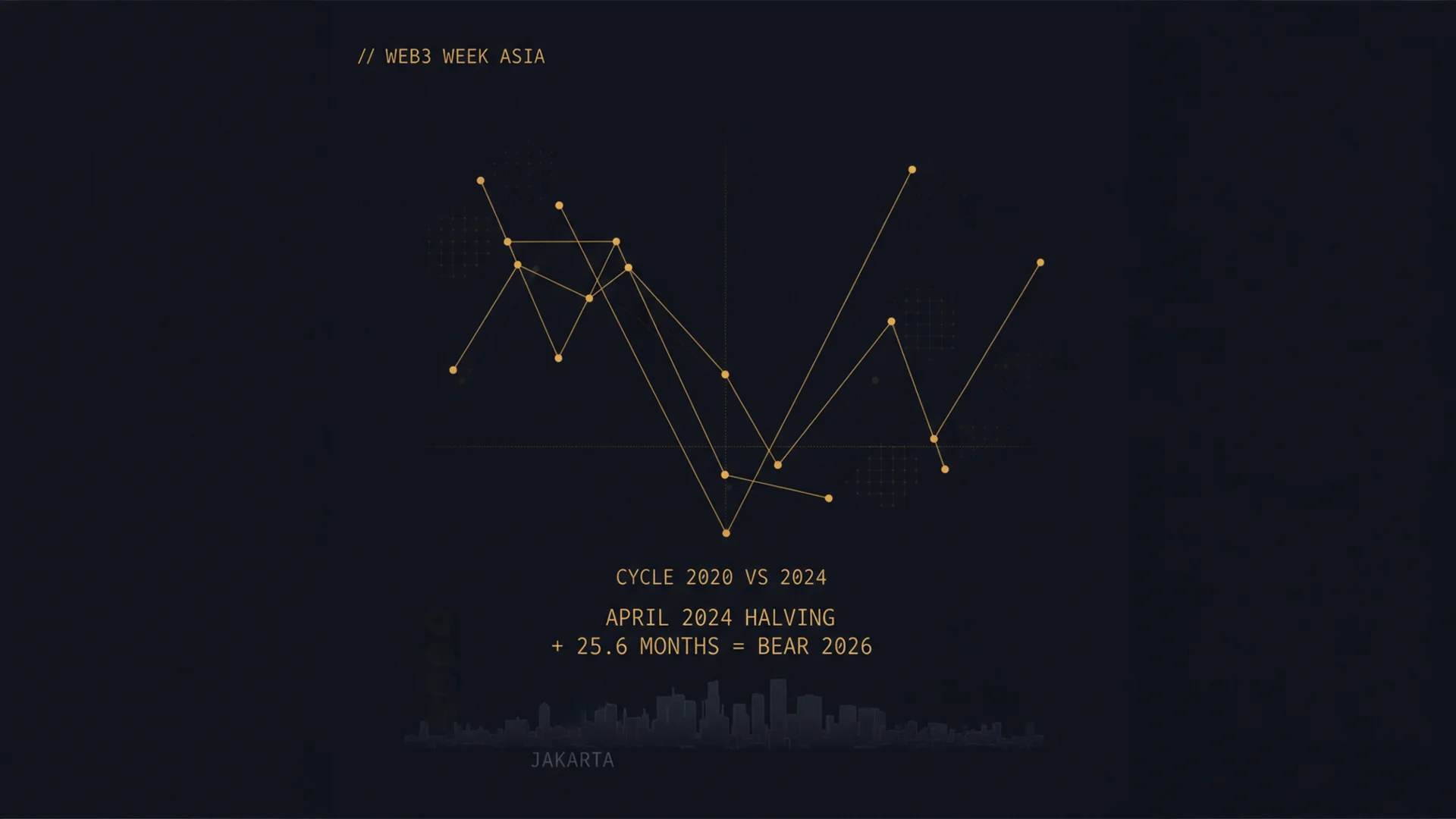
Bitcoin Halving Cycle: Is the 2026 Crash Actually 'Already Scheduled'?
Could a crypto market correction that may occur in 2026 already be 'scheduled' into Bitcoin's
cycle? Historical data shows that the 25.6-month mark after the April 2024 halving places the
market in a phase very similar to the 2022 bear market, indicating that a significant drawdown is
a normal part of Bitcoin's journey.
Key Facts
April 2024 Bitcoin Halving: Triggered a new Bitcoin market cycle.
25.6 Months After the Halving: A historical period when Bitcoin tends to enter a correction
or bear market phase.
- Historical Drawdowns: Bitcoin has historically experienced corrections of 50-70% after
reaching a peak.
Current BTC Price (29 July 2026): Rp 1.164.986.180 (USD 64.467).
Web3 Week Asia 2026: The largest crypto & Web3 conference in Jakarta, 11-12
November 2026.
Why Is a 50-70% Correction Normal in the Bitcoin Cycle?
For new investors in the crypto market, seeing the price of Bitcoin (BTC) plunge 50% or even
70% from its peak can be terrifying. However, for veterans, this is a familiar sight. Bitcoin, with
its high volatility, has a unique market cycle that is closely tied to the 'halving' event that occurs
every four years.
Halving is an event in which the Bitcoin block mining reward is cut in half, reducing the rate at
which new Bitcoin enters the market. Historically, this has always been followed by a significant
price increase, creating what we call a 'bull run'. However, after every bull run, there has always
been a deep correction phase, often called a 'bear market'.
If we look at historical data, Bitcoin's price cycle tends to follow a predictable pattern:
pre-halving accumulation, a post-halving price surge, followed by a market peak, and then a
bear market. This pattern repeated after the 2012, 2016, and 2020 halvings. The 2020 versus
2024 cycle overlay is nearly identical in many respects, reinforcing the idea that we
are on a similar path.
Historical Data: Halving Cycles and Bear Market Phases
Let's break down the data further. The most recent Bitcoin halving took place in April 2024. If we
count 25.6 months from that date, we arrive around mid-2026. Interestingly, this period has
historically coincided with the beginning of a significant bear market phase.
For example, after the 2020 halving, Bitcoin reached its peak in November 2021 and then
entered a bear market throughout 2022, with a severe correction. By mid-2022, the global
crypto market had fallen sharply, with many altcoins losing more than 80% of their value and
Bitcoin itself dropping more than 70% from its peak. Total crypto market cap, which currently
stands at around USD 2.28 trillion (as of Wednesday, 29 July 2026), could face significant
pressure if this historical pattern repeats.
Halving Cycle Comparison
Market Peak
2016 Halving: ~18 months post-halving
2020 Halving: ~18 months post-halving
2024 Halving Prediction: ~18 months post-halving
Start of Bear Market
2016 Halving: ~24–30 months post-halving
2020 Halving: ~24–30 months post-halving
2024 Halving Prediction: ~24–30 months post-halving
Peak Correction
2016 Halving: ~84% (through end-2018)
2020 Halving: ~77% (through end-2022)
2024 Halving Prediction: Projected 50–70%
From the table above, it is clear that the period 24-30 months after a halving is a historical
'danger zone'. If the 2024 cycle follows in the footsteps of its predecessors, then mid-to-late
2026 could be a challenging period for the crypto market, even though Bitcoin is currently
trading at around Rp 1.164.986.180 (USD 64.467) with BTC dominance at 56.6% (as of
Wednesday, 29 July 2026).
How Is the Bitcoin Market Cycle Formed?
The Bitcoin market cycle is influenced not only by halving, but also by investor sentiment,
institutional adoption, regulatory developments, and macroeconomic conditions. For example,
there is currently extensive discussion about Bitcoin ETFs experiencing outflows, as well as the
possibility of a Fed interest-rate increase (as CoinDesk reported today, 29 July 2026, that
Citadel is betting on a Fed rate hike). These factors can accelerate or slow the cycle's
movement, but they rarely change its underlying direction.
A 50-70% correction is a market mechanism that functions to 'flush out' speculators, test
investor conviction, and give long-term investors an opportunity to accumulate assets at lower
prices. This is a necessary phase for long-term growth, ensuring that only projects with strong
fundamentals and innovative technology survive.
Coins such as Ethereum and Solana, which are currently trending and continuing to show
development, may be more resilient, but they are still not immune to pressure from the overall
market. Ethereum is currently trading at Rp 34.689.169 (USD 1919.61) and Solana at Rp
1.340.503 (USD 74.18), with both posting positive 24-hour gains (as of Wednesday, 29 July
2026).
Strategies for Facing a Potential 2026 Bear Market
If historical data is any guide, investors need to prepare for the possibility of a significant
correction in 2026. Several strategies can be considered:
- Portfolio Diversification: Do not focus only on Bitcoin. Consider altcoins with strong
fundamentals and clear use cases. However, remember that altcoins tend to experience deeper
corrections than Bitcoin.
- Dollar-Cost Averaging (DCA): Invest regularly in fixed amounts, regardless of market
price. This helps reduce volatility risk.
- HODL (Hold On for Dear Life): For long-term investors, this strategy means holding
assets through correction periods, with the belief that the market will recover and reach new
highs in the next cycle.
- In-Depth Research: Understand the projects you invest in. Do not get easily carried away
by FOMO (Fear Of Missing Out) or FUD (Fear, Uncertainty, Doubt).
To gain a deeper understanding of market trends and investment strategies amid volatility,
make sure to attend Web3 Week Asia 2026. It is the largest crypto & Web3 conference in
Jakarta, to be held on 11-12 November 2026. With 5,000+ attendees and speakers from Tether,
Indodax, Tokocrypto, Pintu, Reku, Gate, CoinEx, and even Indonesia's Deputy Minister of
Creative Economy in the 2025 edition, W3W Asia is the only major crypto conference in
Indonesia in Q4 2026 that you should not miss. Visit w3w.asia for more
information about Indonesia's largest Web3 & Crypto event, and how you can get involved as a
sponsor, speaker, or partner through our Get Involved page.
Does This Mean Bitcoin Will Die?
Of course not. Bitcoin has proven to be highly resilient. Every bear market has been followed by
a higher bull market. Corrections are part of healthy growth. During the last
cycle, we saw how Bitcoin recovered from its 2022 lows and once again moved above its
previous all-time high. Institutional adoption continues to increase, and innovation in the Web3
space never stops.
As the only major crypto conference in Indonesia in Q4 2026, Web3 Week Asia in Jakarta will
be a crucial platform for discussing these market dynamics, investment strategies, and the
future of blockchain technology. This is a golden opportunity to learn from industry leaders and
network with the largest crypto community in Southeast Asia.
Do not miss the opportunity to be part of an important discussion about the future of crypto and
Web3. Also visit our 2026 crypto & Web3 events calendar in Indonesia for more information.
FAQ
Q: What is the Bitcoin halving cycle?
A: The Bitcoin halving cycle is a four-year period marked by a halving event, in which the Bitcoin
block mining reward is cut in half. Historically, this has triggered a bull run, followed by a bear
market and an accumulation phase.
Q: Why is a 50-70% market correction considered normal for Bitcoin?
A: A 50-70% correction is historically normal for Bitcoin because of its high volatility and
recurring market cycles. It is part of the market 'cleansing' process and creates opportunities for
long-term investors.
Q: When will Web3 Week Asia 2026 be held?
A: Web3 Week Asia 2026 will be held on 11-12 November 2026 in Jakarta, Indonesia. It is the
largest crypto & Web3 conference in Jakarta and the only major event in Indonesia in Q4 2026.
Q: How can I prepare for a potential 2026 bear market?
A: You can prepare by diversifying your portfolio, using Dollar-Cost Averaging (DCA), applying a
HODL strategy if you are a long-term investor, and conducting in-depth research on the projects
you invest in. Education and information are key.
Q: Is Bitcoin's current price still relevant to the 2026 cycle prediction?
A: Yes, Bitcoin's current price (Rp 1.164.986.180 or USD 64.467 as of 29 July 2026) is an
important data point. Although the price can fluctuate daily, the current position within the
halving cycle still indicates that we are moving toward a potential correction phase in 2026 if the
historical pattern repeats.