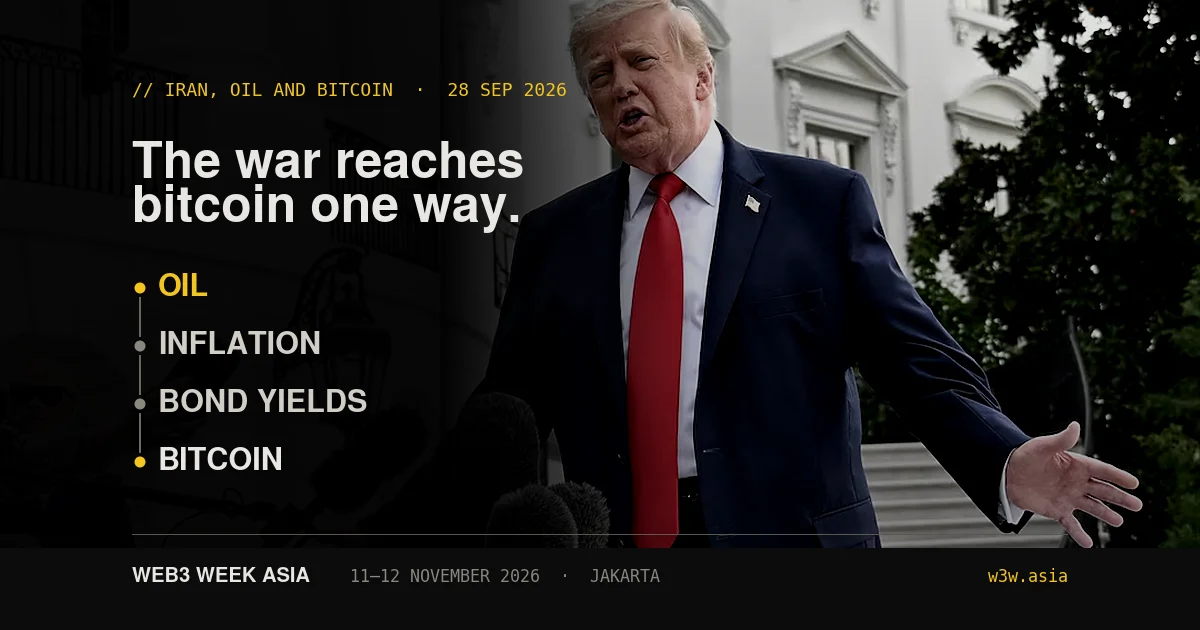
On Sunday 27 September, Donald Trump said the United States would win its war with Iran very soon. Asked whether there could be more strikes before the US midterm elections, he did not rule it out.
By 03:30 UTC on Monday, bitcoin was down 1.3 per cent at US$83,324. Nasdaq futures were down 0.7 per cent. West Texas Intermediate crude was up nearly one per cent, at about US$93.
A one per cent move on a war headline is worth understanding, because it tells you where the real risk sits. It is not in the missiles. It is in what they do to the oil price.
What Trump said
Two lines from the weekend carry the market-relevant content.
On the war: "I think what's going to happen is we're going to win this war very soon, and as soon as we win it, the oil will go down, way down to what it was before the war."
On more strikes before the 3 November midterms: "I don't want to say that. I mean, it's possible, but I just don't want to say that."
The same weekend, according to Fox News, Iranian President Masoud Pezeshkian signalled that Tehran remained open to nuclear talks if Washington showed it was not seeking regime change, and Trump rejected Iran's latest ceasefire proposal as unacceptable.
That leaves roughly five weeks, until 3 November, in which the president has said further strikes are possible.
The quarter this happened in
The timing is striking. Bitcoin is two trading days from closing its third quarter up roughly 42 to 44 per cent, depending on the day you measure. It started the quarter near US$58,500.
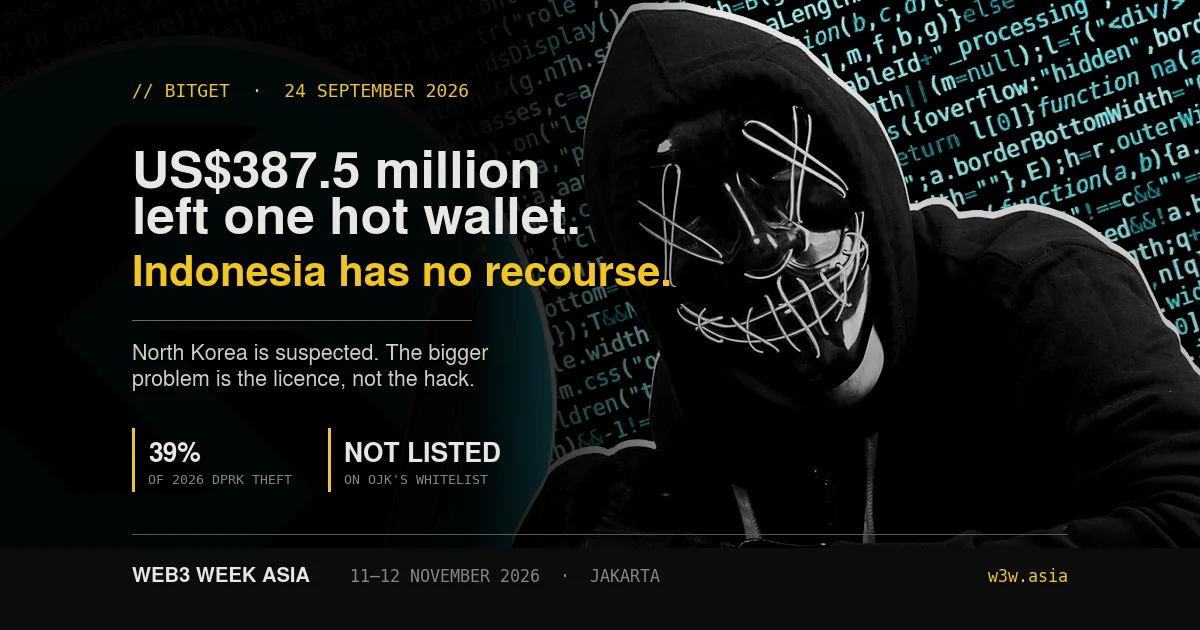
That would be its second-best third quarter on record, behind 2017, and it came in a quarter that included an escalation of the Iran war, the first Federal Reserve rate increase in three years, the failure of the CLARITY Act in the Senate, and a US$387.5 million exchange hack.
Whatever else is true, missiles did not stop this quarter.
Why strike headlines barely move bitcoin
The war has now run since early March. Monday's reaction was a 1.3 per cent fall. For context, bitcoin rose 5.9 per cent on 18 September and fell 2.1 per cent on 24 September, both on news that had nothing to do with Iran. A move of this size on a strike headline sits inside the asset's ordinary daily range.
That is not because markets are indifferent to war. It is because bitcoin has no direct exposure to it. It has no factories in the Gulf, no shipping routes, no oil import bill. The war reaches it only indirectly, and the indirect route is slow and specific.
The channel that does matter: oil
The route runs like this.
Oil sets inflation expectations. Energy feeds straight into consumer prices. US inflation was running at 3.4 per cent in August, with gasoline prices up 3.9 per cent in that month alone, according to figures cited by Fortune.
Inflation sets bond yields. The US 10-year Treasury yield has risen above 5 per cent this month for the first time since 2007. CoinDesk put it at about 5.2 per cent on Monday.
Yields set the cost of holding bitcoin. When a risk-free government bond pays over 5 per cent, a volatile asset with no yield has to work harder to justify its place in a portfolio. That pressure is constant, not headline-driven.
So a strike that does not change the oil price is mostly noise. A strike that closes shipping lanes and sends crude back above US$100 is a different event entirely, because it feeds the one variable that has actually moved bitcoin this year.
Two versions of the Strait of Hormuz
This is where the next five weeks get genuinely uncertain.
Over the weekend, Trump said the United States had total control of the Strait of Hormuz and that more than 20 million barrels of oil had moved through it on Friday night, exceeding pre-war levels. That claim has not been independently confirmed.
Earlier this month, tanker tracking data from Kpler, reported by Al Jazeera, showed traffic through the strait down to around five vessels a day, against roughly a hundred before the war.
Both cannot describe the same conditions. If the president's figure holds, the oil risk premium should keep falling and yields should follow. If the tracking data is closer to the truth, the market is underpricing supply risk.
The oil price will settle which version is right faster than any statement will. That is the number to watch.
The honest counterweight
A real supply shock would change all of this. The argument that war headlines barely move bitcoin holds only while oil stays contained. A strike on Gulf production or a verified closure of Hormuz would reach crypto within days through the channel described above.
Correlation with equities has been high. Bitcoin and Nasdaq futures fell together on Monday. When both markets are driven by the same rate expectations, bitcoin offers less diversification than its advocates claim.
One strong quarter does not predict the next. A 42 per cent gain says a great deal about July to September and nothing reliable about October to December.
What it means from Jakarta
For Indonesian traders, the calendar is worth noting.
The window in which Trump has said more strikes are possible closes on 3 November. The US midterm result will be known a few days later. Web3 Week Asia opens in Jakarta eight days after election day.
That means the largest known source of scheduled political risk for this quarter will have resolved before the region's crypto industry meets in November. Whatever the oil price and the bond market have decided by then will be the backdrop, rather than a forecast.
Locally, OJK data showed transaction value falling 28.2 per cent in July to Rp20.52 trillion even as registered accounts rose to 22.93 million. The September figures, when they arrive, will show whether a record quarter in dollar terms brought Indonesian volume back with it.
Web3 Week Asia: Jakarta, 11-12 November 2026
Web3 Week Asia takes place on 11-12 November 2026 in Jakarta, Indonesia. It is a two-day blockchain event covering markets, regulation, infrastructure and venture investment across Southeast Asia, with OJK, licensed exchanges, funds and founders in the same building.
The 2025 edition drew more than 5,000 participants, over 100 speakers and more than 200 companies.
Landing a week after the US midterms makes it the first major Indonesia crypto event where the fourth quarter can be discussed with the biggest scheduled political risk already behind it.
Frequently asked questions
Why did bitcoin fall on 28 September 2026?
Bitcoin fell about 1.3 per cent to US$83,324 by 03:30 UTC after Donald Trump said on 27 September that more strikes on Iran were possible before the 3 November midterm elections. Nasdaq futures fell 0.7 per cent and WTI crude rose nearly one per cent over the same period.
How does the Iran war affect bitcoin?
Mostly indirectly, through oil. Higher oil prices lift inflation, which pushes up bond yields, which raises the cost of holding a non-yielding asset like bitcoin. Strike headlines that do not move oil have produced only small moves. The US 10-year Treasury yield rose above 5 per cent in September 2026 for the first time since 2007.
How did bitcoin perform in Q3 2026?
Bitcoin rose roughly 42 to 44 per cent in the third quarter of 2026, from about US$58,500 at the start of July, depending on the day measured. That would make it the second-best third quarter on record after 2017.
When and where is Web3 Week Asia 2026?
Web3 Week Asia takes place on 11-12 November 2026 in Jakarta, Indonesia. It is a two-day crypto and blockchain event covering markets, regulation, infrastructure and venture investment across Southeast Asia.
Sources
Bitcoin and Nasdaq futures decline as Trump won't rule out more Iran strikes, CoinDesk, 28 September 2026: https://www.coindesk.com/markets/2026/09/28/bitcoin-and-nasdaq-futures-decline-as-trump-won-t-rule-out-more-iran-strikes
What actually drove bitcoin back above US$85,000 earlier this month, our earlier analysis: https://www.w3w.asia/articles/bitcoin-85000-rally-september-2026
Trump's remarks are from CoinDesk and FXStreet; the Pezeshkian comments and the Hormuz traffic claim are from Fox News live coverage of 27 September. The Kpler tanker figures are from Al Jazeera's reporting earlier in September. The 10-year yield reaching its highest level since 2007 is from CNBC, CNN and Fortune; inflation figures are from Fortune. Third-quarter performance is from Bitcoin.com and KuCoin. The 18 September and 24 September daily moves are from The Block and Yahoo Finance respectively. Indonesian figures are from OJK as reported by CNBC Indonesia and Kompas.
Methodology: several outlets dated Trump's remarks to Monday 28 September; the remarks were made on Sunday 27 September, as Fox News live coverage and CoinDesk's reference to "Sunday" both show. The third-quarter return is given as a range because it was measured two trading days before the quarter closed and published estimates vary between 42 and 44 per cent with the day chosen. The exact 5.2 per cent yield figure is from CoinDesk alone; the fact that yields passed 5 per cent for the first time since 2007 is confirmed by multiple outlets. The presidential claim about Hormuz volumes is reported as a claim and has not been independently verified.
This article is for information only and is not investment advice.