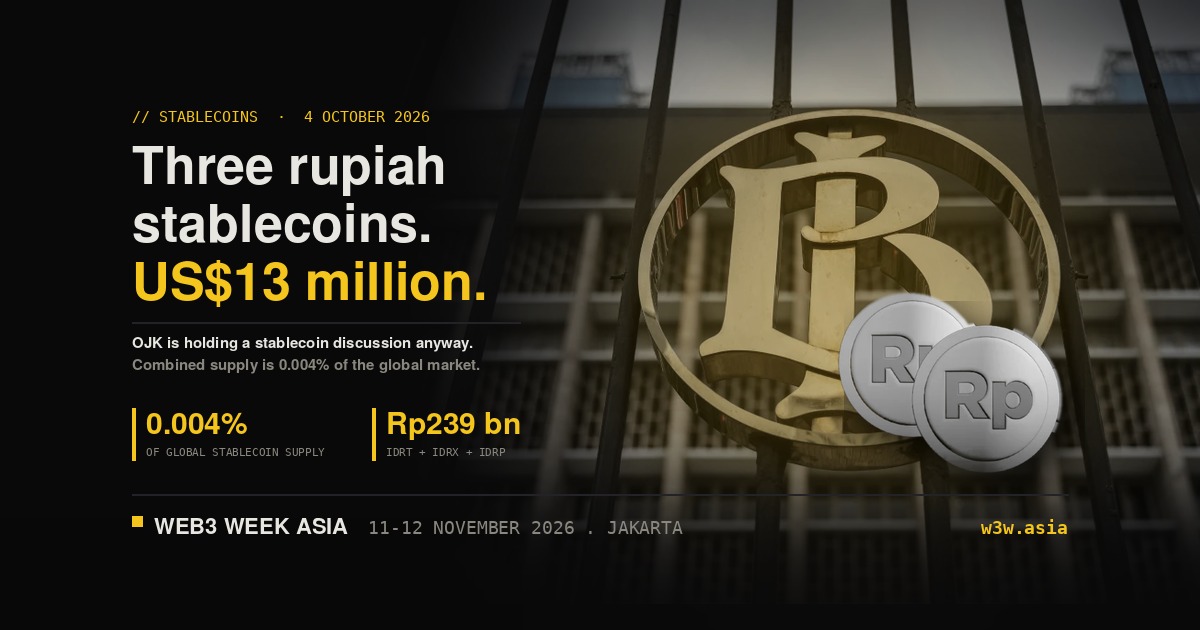
Indonesia's financial regulator has put stablecoins on a dedicated agenda, but the rupiah-pegged tokens that already exist are small enough to fit inside a rounding error. Adding up the three rupiah stablecoins that can be priced from public data gives roughly Rp239 billion, about US$13 million. The overlooked detail is not the size alone. It is the gap between how little rupiah stablecoin exists and how much regulatory attention it is already getting.
That gap matters for anyone planning around Indonesia's digital asset rules. The numbers below are as of 4 October 2026, written for readers heading to Web3 Week Asia, the crypto and blockchain event in Jakarta on 11-12 November 2026.
The headline number. Three rupiah stablecoins add up to about Rp239 billion, or roughly US$13 million at the Bank Indonesia JISDOR reference rate of Rp17,898 per dollar on 2 October 2026.
The comparison. That is about 0.004% of the roughly US$306.9 billion global stablecoin market that DefiLlama showed on 4 October 2026.
The regulatory signal. According to Blockchain Media, OJK has scheduled a special stablecoin discussion on 8 October 2026 titled "Stablecoin dalam Ekosistem Keuangan Digital".
The sandbox. The IDRP rupiah stablecoin passed OJK's regulatory sandbox on 11 June 2026, according to Blockchain Media and the issuer's own site.
The user base. OJK data reported for June 2026 shows 22.69 million crypto consumers in Indonesia.
What the supply numbers actually say
Start with the three tokens. Rupiah Token (IDRT) has a circulating supply of about 173.9 billion tokens on both CoinGecko and CoinMarketCap, which at a one-to-one peg is about Rp173.9 billion, or US$9.7 million. IDRX shows about 18.5 billion tokens on CoinMarketCap, or about Rp18.5 billion and US$1.0 million. IDRP had about 46.68 billion tokens in circulation on 3 October 2026, according to Blockchain Media, or about Rp46.7 billion and US$2.6 million.
Adding the three gives about Rp239 billion. For scale, OJK data reported for June 2026 put crypto transaction value at Rp28.58 trillion, so the three rupiah stablecoins combined equal about 0.84% of that figure.
Why it matters: a stablecoin is useful only if people hold it to settle trades or payments. Supply of this size suggests rupiah stablecoins are a niche tool today, not a core rail. Trading volume points the same way. CoinGecko listed 24-hour volumes of only US$33 for IDRT and about US$4,500 for IDRX at the time of checking.
Why the OJK sandbox matters more than market size
OJK has already tested stablecoins in its sandbox. OJK Chair Friderica Widyasari Dewi said on 24 September 2026 that the sandbox has covered gold tokenization, government securities, property economic rights, crypto asset funds, digital asset custodians and stablecoins, and that the tests look at technology readiness, business model, risk management and consumer protection.
IDRP is the clearest example. According to Blockchain Media, its issuer, PT Adhyoka Berkah Maju, holds about Rp47.04 billion in escrow at BNI and Bank Nationalnobu against about Rp46.68 billion of tokens, a ratio of about 100.8% on escrow alone. OJK's roadmap for 2026-2031, presented on 2 July 2026, lists stablecoin regulation and asset tokenization among its priorities, according to Ajaib.
An OJK official said in a keynote at the Coinfest Asia conference in Bali that stablecoins would be treated as transactional instruments, not payment tools, according to a U.Today press release. A press release is not a regulation.
Why it matters: a small base is when issuers can still shape reserve, redemption and disclosure terms.
What Singapore and Hong Kong have already written down
Two neighbours show the template. Singapore's MAS opened a consultation on 1 September 2026 that closes on 16 October 2026. Its proposals include a stablecoin issuance licence, reserves equal to 100% of the par value of outstanding tokens, redemption at par within set timeframes, quarterly liquidity stress tests and wind-down plans, according to Sidley.
Hong Kong awarded its first stablecoin issuer licences on 10 April 2026, to HSBC and Anchorpoint, a joint venture of Standard Chartered Bank (Hong Kong), Hong Kong Telecom and Animoca Brands, according to Central Banking and CoinReporter.
Why it matters: both frameworks start from the same three questions, namely what backs the token, who can redeem and on what terms, and who is licensed to issue. Indonesia's 8 October discussion, as described by Blockchain Media, lists backing asset quality, issuer governance and consumer transparency, which are the same questions.
The honest counterweight
Small supply is not weak demand. Supply measures what has been issued, not what Indonesians use. Indonesian users who hold dollar stablecoins are not captured in a rupiah-token count, and this data does not show how many do.
An agenda item is not a rule. The data shows OJK scheduled a discussion. It does not show what OJK will decide, and no draft stablecoin regulation was found in the sources reviewed.
The price data is messy. CoinMarketCap showed IDRT at a market capitalisation of US$2.07 million with a price that does not match the one-to-one rupiah peg, while CoinGecko showed US$9.77 million. The peg-based calculation above (about US$9.7 million) agrees with CoinGecko. Also, IDRP's self-reported circulating supply on CoinMarketCap (31.42 billion) differs from the 46.68 billion reported for 3 October 2026, and the dates of those two figures differ.
Indonesia crypto: where a rupiah stablecoin could and could not fit
Indonesia's crypto base is large. OJK data reported for June 2026 counts 22.69 million consumers and Rp28.58 trillion in transaction value, according to Investortrust, and the same 22.69 million figure appears in a U.Today press release.
In the Indonesia crypto market the open question is use, not users. A rupiah token that settles trades without a dollar conversion, or supports tokenized assets, needs depth and licensed issuers. Neither is visible in the supply data yet.
Web3 Week Asia 2026: blockchain event in Jakarta, 11-12 November
Web3 Week Asia 2026 takes place on 11-12 November 2026 in Jakarta, Indonesia. According to the official programme, it is organised around four tracks: Investor Meetups, Alpha Callers, Web3 Entrepreneur, and Indonesia Crypto Outlook 2026.
Stablecoin rules sit directly inside that last track's subject area: how reserves, licensing and exchange access will shape Indonesia's market. The 2026 speaker line-up has been described by the organisers as to be announced, so no sessions are listed here.
The 2025 edition drew more than 5,000 participants, over 100 speakers and more than 200 companies from more than 10 countries, according to the organisers.
Frequently asked questions
When and where is Web3 Week Asia 2026?
Web3 Week Asia 2026 takes place on 11-12 November 2026 in Jakarta, Indonesia. It is a two-day crypto and blockchain event covering markets, regulation, infrastructure and venture investment across Southeast Asia.
Are there rupiah stablecoins in Indonesia?
Yes. IDRT, IDRX and IDRP are rupiah-pegged tokens. Combined supply is about Rp239 billion (roughly US$13 million) as of early October 2026, based on CoinGecko, CoinMarketCap and Blockchain Media data.
Did OJK approve a rupiah stablecoin?
IDRP passed OJK's regulatory sandbox on 11 June 2026, according to Blockchain Media and the issuer. Passing a sandbox is a test outcome. It is not the same as a full licence under a final stablecoin regulation, which was not found in the sources reviewed.
How does Indonesia's approach compare with Singapore and Hong Kong?
Singapore's MAS proposes a stablecoin issuance licence with 100% reserves, and its consultation closes on 16 October 2026. Hong Kong awarded its first issuer licences on 10 April 2026. Indonesia has used a sandbox and a 2026-2031 OJK roadmap so far.
Are rupiah stablecoins legal tender?
No. Blockchain Media states that IDRP is not legal tender and is separate from Bank Indonesia's Rupiah Digital project.
Sources
Blockchain Media, OJK stablecoin agenda and IDRP supply: https://blockchainmedia.id/stablecoin-masuk-agenda-khusus-ojk-indonesia-sudah-punya-eksperimen-rupiah-digital-idrp/
Web3 Week Asia, earlier analysis: https://www.w3w.asia/articles/indonesia-crypto-market-2026-jakarta-web3-hub
Token supply and prices come from CoinGecko and CoinMarketCap pages for IDRT and IDRX, checked on 4 October 2026, and from Blockchain Media (3 October 2026) for IDRP. The global stablecoin total comes from DefiLlama (4 October 2026). The USD/IDR rate is the Bank Indonesia JISDOR reference of Rp17,898 on 2 October 2026, as posted by Bank Indonesia and reported by Kliksumut. OJK consumer and transaction data for June 2026 come from Investortrust and U.Today. The OJK Chair's remarks of 24 September 2026 come from CNN Indonesia and Jawa Pos. The OJK roadmap date comes from Ajaib. MAS consultation details come from Sidley and Fintech Asia. The Hong Kong licences come from Central Banking and CoinReporter.
Methodology: Rupiah values equal circulating token supply multiplied by Rp1, assuming a one-to-one peg. US dollar values divide rupiah values by Rp17,898 per dollar. The 0.004% share equals US$13.36 million divided by US$306.9 billion, and the 0.84% share equals Rp239.07 billion divided by Rp28.58 trillion. The 100.8% escrow ratio equals Rp47.04 billion divided by Rp46.68 billion. IDRT's CoinMarketCap market capitalisation was excluded because its price conflicts with the peg. IDRP's supply rests on one source and is attributed. Other rupiah stablecoins may exist that were not found, so the total is a floor, not a census.
This article is for information only and is not investment advice.