Indonesia Crypto Market 2026: Why the World's Web3 Builders Are Booking Flights to Jakarta
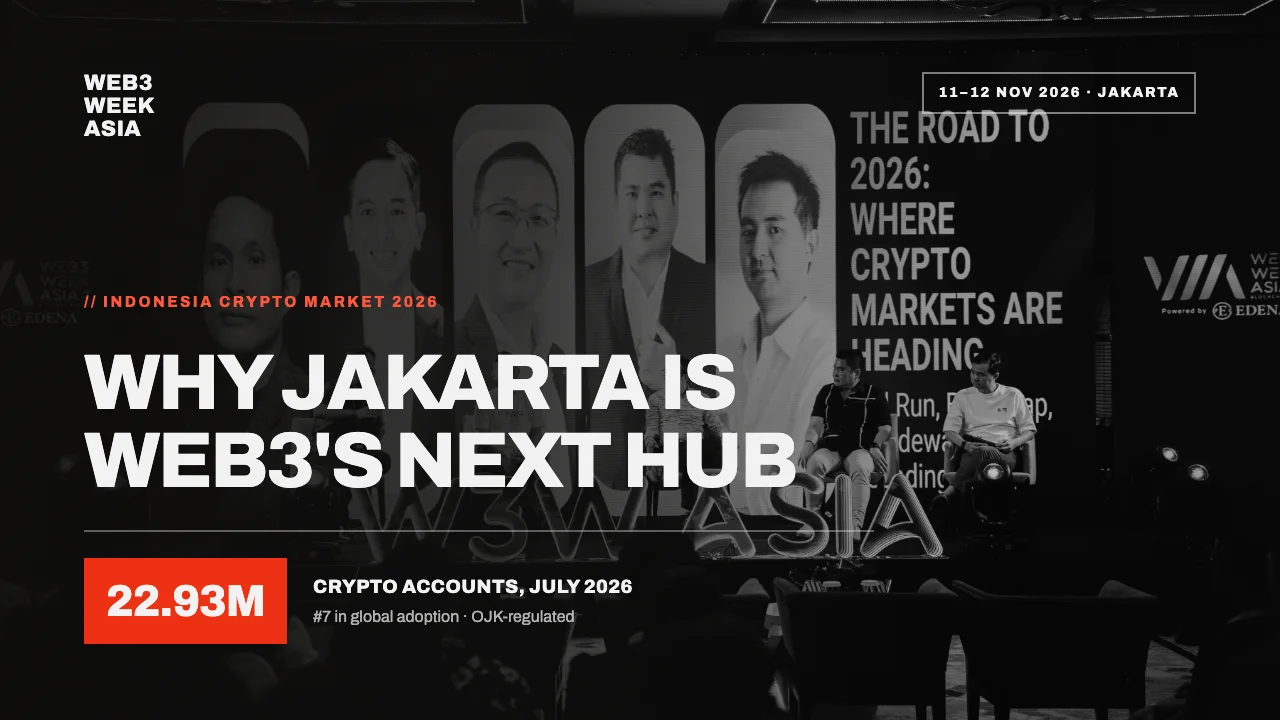
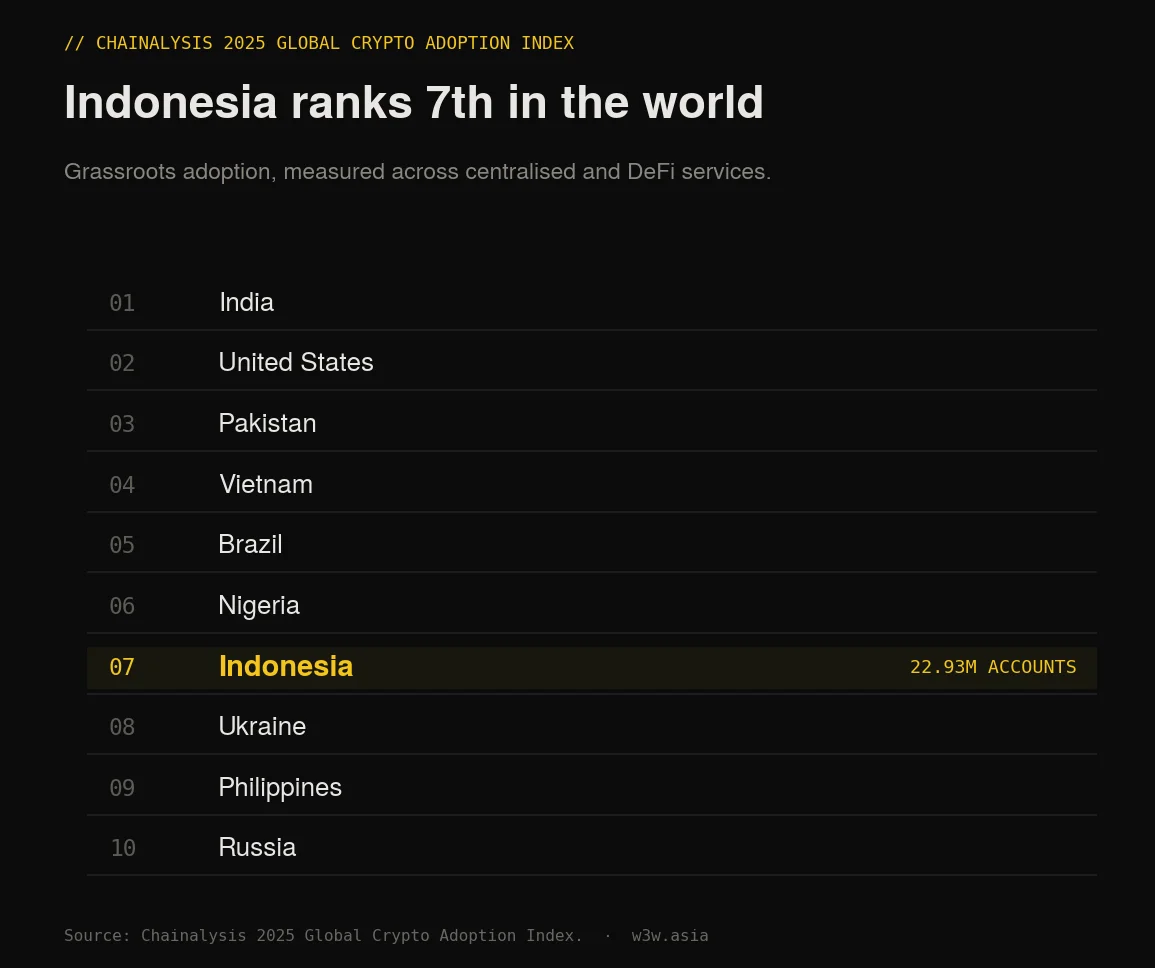
Indonesia is now the seventh-largest crypto adoption market on earth and the largest retail crypto user base in Southeast Asia. As of July 2026, 22.93 million crypto accounts were registered with Otoritas Jasa Keuangan (OJK), Indonesia's financial services authority - up from 20.19 million at the close of 2025, a period in which prices gave investors very little to celebrate. That is the detail global teams keep underestimating: Indonesian adoption kept compounding while the market cooled, and it did so under a regulator that formally took control of the asset class in January 2025. For anyone mapping their 2026 expansion, that combination is the whole argument for showing up in Jakarta.
Key Facts: Indonesia's Crypto Market (July 2026)
22.93 million crypto accounts registered with OJK as of July 2026, up from 22.69 million in June and 21.37 million in March 2026.
Rp 20.52 trillion (approx. US$1.14 billion) in crypto asset transactions in July 2026, plus Rp 3.41 trillion in digital asset derivatives.
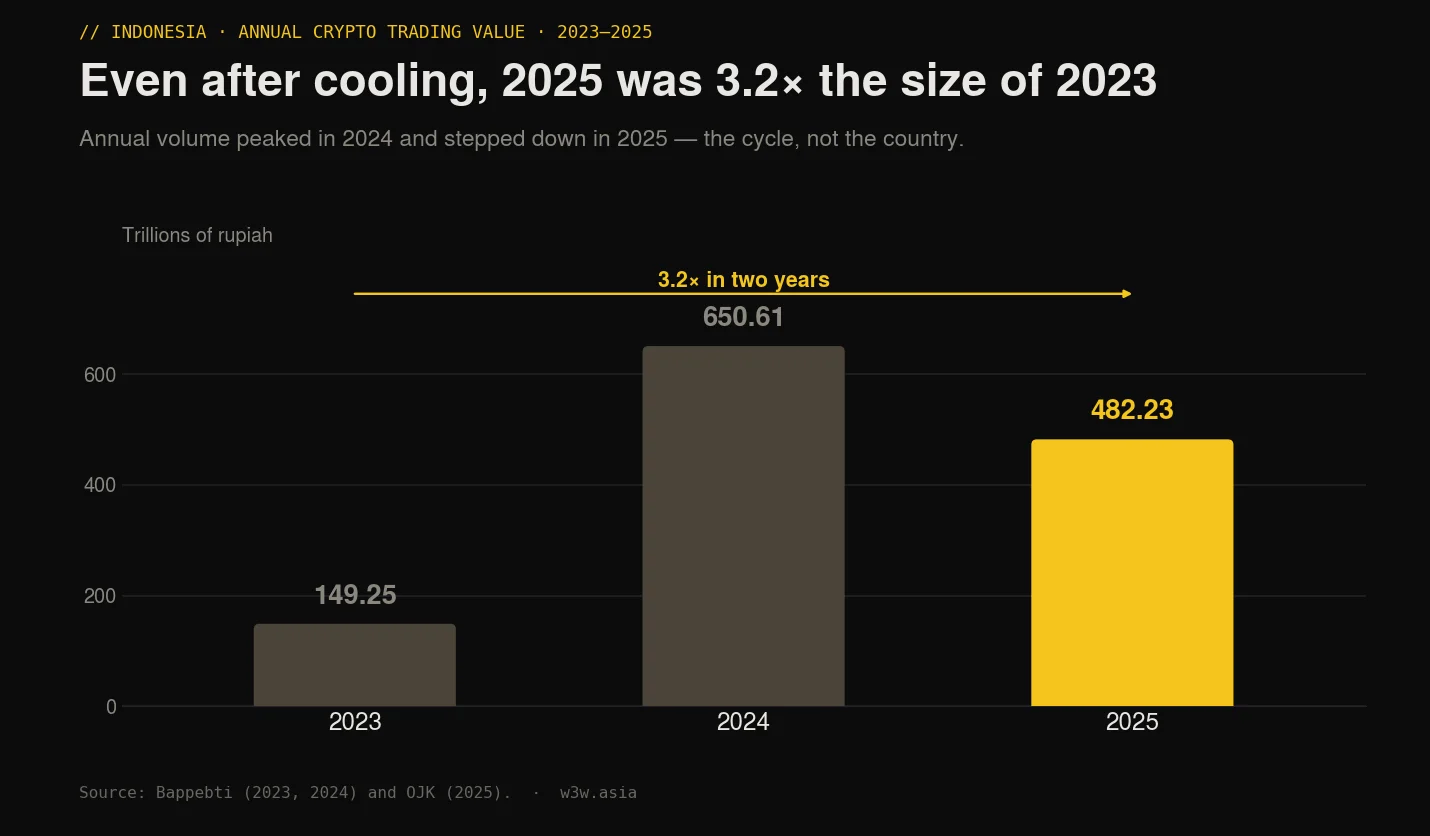
Rp 482.23 trillion (approx. US$27 billion) traded across full-year 2025, against Rp 650.61 trillion in 2024 (OJK and Bappebti data).
Rank #7 globally in the Chainalysis 2025 Global Crypto Adoption Index, ahead of Ukraine, the Philippines and Russia.
APAC grew fastest of any region, with on-chain value received up 69% year over year, from US$1.4 trillion to US$2.36 trillion (Chainalysis, 2025).
OJK has been the regulator since 10 January 2025, with 31 licensed entities and 1,464 tradeable crypto assets under supervision.
Crypto tax was cut and simplified on 1 August 2025: 0.21% final income tax on licensed domestic exchanges, 1% offshore, VAT on asset transfers removed.
288 million people, median age 30.7, and 60.3% living in cities (UN data, July 2026).
Web3 Week Asia 2026 - Indonesia's flagship crypto and blockchain event - runs 11-12 November 2026 in Jakarta, following a 2025 edition with 5,000+ participants from 10+ countries.
USD figures are approximate, converted at roughly IDR 18,000 per US dollar.
How big is Indonesia's crypto market in 2026?
Big enough that the monthly numbers now read like a mid-sized national exchange rather than an emerging-market experiment.
OJK's monthly reporting gives a complete 2026 series: Rp 29.24 trillion in January, Rp 24.33 trillion in February, Rp 22.24 trillion in March, Rp 22.98 trillion in April, Rp 23.01 trillion in May, Rp 28.58 trillion in June - a 24.2% month-on-month jump that Adi Budiarso, OJK's Head of Executive for Supervision of Financial Sector Technology Innovation, Digital Financial Assets and Crypto, called a sharp increase - and Rp 20.52 trillion in July. Derivatives on digital assets added another Rp 3.41 trillion in July.
Read that series honestly and it tells you two different things at once. Trading volume in Indonesia is cyclical. It swings 25% or more month to month, tracking global price action exactly as you would expect from a retail-heavy market, and OJK itself attributes the early-2026 softness to Middle East geopolitics and US interest rates forcing liquidations in leveraged positions. The user base is not cyclical. It went from 19.56 million accounts in November 2025 to 20.19 million in December, 20.70 million in January 2026, roughly 21.1-21.4 million through the spring, 22.69 million in June and 22.93 million in July - about 3.4 million net additions in eight months, through a market that spent most of the period drifting.
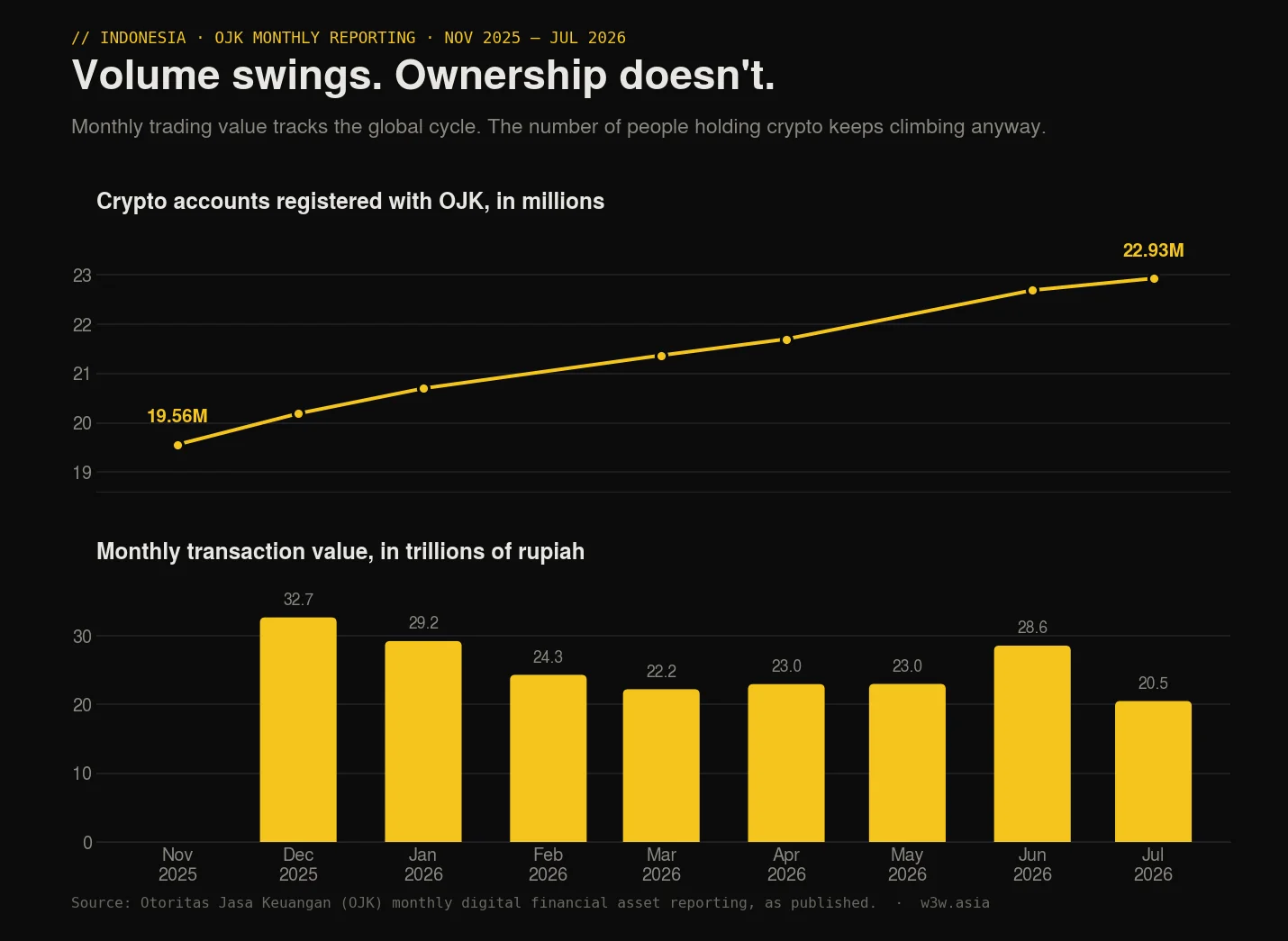
Full-year totals give the same picture with a longer lens. Indonesia traded Rp 650.61 trillion in 2024, a 335% jump on 2023, then Rp 482.23 trillion in 2025 - a cyclical step down in rupiah volume while the number of people holding crypto rose. Volume follows the cycle. Ownership ratchets.
The market structure behind those numbers has also consolidated. Indodax alone accounted for 9.9 million users and 46.5% of the market in March 2026, with Tokocrypto, Pintu and Reku holding the rest of the meaningful share. OJK supervises 31 licensed entities spanning exchanges, clearing, custody and trading, and 1,464 crypto assets approved for trading.
Why do nearly 23 million Indonesians hold crypto?
Start with the demographics, because they explain more than any narrative does. Indonesia has 288 million people, a median age of 30.7, and 60.3% urbanisation. This is the fourth most populous country in the world, and its median citizen was born after the internet.
Layer on how those people already bank. Indonesia went mobile-first without ever going desktop-first; QR payments, digital wallets and app-based brokerages became normal here faster than they did in most developed markets. Buying crypto through an app is not a leap in behaviour - it is the same gesture as paying for coffee.
The Chainalysis 2025 index points to the same drivers across the region: remittances, mobile-first finance, and access to dollars through stablecoins. That last one carries real weight in an economy where the rupiah's path against the dollar is a household conversation, not an FX desk abstraction. APAC as a whole recorded a 69% year-on-year increase in on-chain value received, taking regional volume from US$1.4 trillion to US$2.36 trillion - more than double the previous year's 27% growth rate. Indonesia, Vietnam and Pakistan sit at the centre of that shift.
What changed when OJK took over from Bappebti?
Almost everything that matters to an institutional counterparty.
Until the end of 2024, Indonesian crypto sat under Bappebti, the commodity futures regulator inside the Ministry of Trade - legally, crypto was a commodity. On 10 January 2025, under Government Regulation 49/2024 and OJK Regulation 27/2024, supervision moved to OJK, the same authority that oversees banks, insurers and capital markets. Bank Indonesia took the adjacent payments mandate.
The practical consequences:
Crypto is now a digital financial asset, not a commodity. It sits in the same regulatory neighbourhood as securities, which is precisely the framing institutional allocators need before they can act.
Capital requirements have teeth. Licensed traders must meet a minimum paid-up capital of IDR 100 billion and maintain equity of at least IDR 50 billion.
There is now a path for token offerings. OJK's digital financial asset offering framework covers both tokenised real-world assets and crypto assets. Offerings made through Indonesian mass media or to more than 100 parties count as public offerings; those above IDR 1 billion require an OJK licence and approval, while smaller raises are notification-only until cumulative annual offerings cross that threshold.
Foreign issuers must localise. Issuers have to be incorporated as an Indonesian limited liability company (PT), with a majority-Indonesian board and key personnel domiciled locally. You cannot serve this market from Singapore alone.
Derivatives are explicitly in scope, with an OJK framework supervising the Rp 3-5 trillion per month derivatives segment.
Existing Bappebti licences remain valid where they do not conflict with the new rules, and every new or pending application now runs through OJK.
What does crypto tax look like in Indonesia now?
Better than it did, and deliberately tilted onshore.
Under PMK 50/2025, effective 1 August 2025, crypto asset transfers are no longer subject to VAT - a direct consequence of reclassifying crypto from commodity to digital financial asset. Sellers instead pay a final income tax of 0.21% of transaction value on licensed domestic exchanges, versus 1% on foreign platforms. Exchange operators pay 12% VAT on their commissions, and miners providing verification services are charged 2.2% VAT, with general income tax rates applying to mining income from tax year 2026.
The five-fold spread between domestic and offshore rates is not an accident. It is the clearest signal the government has sent about where it wants volume to sit: on regulated, locally licensed venues.
What this means if you are building outside Indonesia
Indonesia is not a market you win with a translated landing page and a Telegram group. It has a regulated, licence-gated venue layer; a retail base that already trusts a handful of domestic brands; a legal requirement to operate through a local entity if you intend to offer assets; and a tax code that prices offshore access at five times onshore.
Every one of those constraints points to the same conclusion. Market entry here runs through relationships - with the licensed exchanges, with Asosiasi Blockchain Indonesia and the community layer, with the local funds and KOLs who actually move retail attention, and increasingly with regulators who are now actively drafting the rules for token offerings and tokenised assets. Those relationships are formed in person, and in Indonesia they are formed in Jakarta.
If tokenised real-world assets are your entry point, our breakdown of RWA tokenization covers why Indonesian property and commodity markets are among the most interesting untapped RWA supply anywhere in Asia.
Where the market meets: Indonesia's biggest crypto and blockchain event in Q4 2026
Web3 Week Asia 2026 takes place on 11-12 November 2026 in Jakarta, Indonesia. It is the country's flagship crypto and Web3 conference and the only major blockchain event on the Indonesian calendar in Q4 2026 - which makes this Indonesia crypto event, for most international teams, the single efficient window into the market all year.
The scale is established rather than promised. The 2024 founding edition drew more than 3,000 attendees. The 2025 edition brought 5,000+ participants, 100+ speakers, 200+ companies and delegations from 10+ countries, with 199+ partners across previous editions including Binance, OKX, Base, Tether, CoinEx, Bitget Wallet, Indodax, Tokocrypto, Pintu, Samsung and Asosiasi Blockchain Indonesia. Past stages have featured Eddy Christian Ng (Expansion Lead, Tether), William Sutanto (Co-Founder and CEO, Indodax), Calvin Kizana (CEO, Tokocrypto), Rob Chiu (Head of APAC, ViaBTC), Wook Lee (CEO and Founder, EDENA) and Indonesia's Deputy Minister of Creative Economy.
The 2026 programme is built around four tracks that map closely to why foreign teams come here in the first place:
Investor Meetups - direct access to funds actively deploying into Southeast Asian Web3.
Alpha Callers - market structure and positioning from traders and analysts operating in this region.
Web3 Entrepreneur - workshops and mentorship for founders building on the ground.
Indonesia Crypto Outlook 2026 - the regulatory and market read from the people setting policy and running the licensed venues.
Early-bird access is currently listed at IDR 55,000 for the Student Pass (student ID required at entry), IDR 550,000 for the General Pass - which adds F&B access and the official after party - and IDR 2,750,000 for the VIP Pass, which includes the exclusive dinner, VIP lounge, curated networking sessions and connection services. Pricing is subject to availability; current tiers are on the tickets page.
Teams that want a stage, a booth or a media partnership rather than a seat should start at Get Involved. The 2026 speaker lineup is being announced progressively on the speakers page, and the side events programme runs across the surrounding week.
Frequently Asked Questions
Is crypto legal in Indonesia?
Yes. Crypto asset trading is legal and regulated. Since 10 January 2025, it has been supervised by OJK as a digital financial asset, with 31 licensed entities and 1,464 approved tradeable assets. Crypto is not legal tender for payments - that remains the rupiah.
Who regulates crypto in Indonesia?
OJK (Otoritas Jasa Keuangan), the Financial Services Authority, under Government Regulation 49/2024 and OJK Regulation 27/2024. Bank Indonesia holds the related payments mandate. Bappebti, the previous regulator, transferred the function in January 2025.
How is crypto taxed in Indonesia?
Since 1 August 2025, sellers pay a 0.21% final income tax on licensed domestic exchanges and 1% on foreign platforms. VAT no longer applies to crypto asset transfers.
What is the biggest crypto event in Indonesia in 2026?
Web3 Week Asia 2026, held 11-12 November 2026 in Jakarta. It is the largest blockchain event in Indonesia and the only major crypto conference in Jakarta in Q4 2026, following a 2025 edition of 5,000+ participants from 10+ countries.
Can a foreign company operate in Indonesia's crypto market?
Not directly for asset offerings. Issuers must be incorporated locally as a PT with a majority-Indonesian board and locally domiciled key personnel. Most foreign teams enter through partnerships with licensed local venues.
The bottom line
The case for Indonesia does not rest on a price forecast. It rests on 22.93 million accounts that kept growing through a flat market, a regulator that moved crypto into the same supervisory frame as banking and capital markets, a tax structure engineered to pull volume onshore, and 288 million people whose median age is 30.
What the data does not give you is a way in. That part is still relationships, and relationships are still made in rooms. The room, this year, is Jakarta on 11-12 November 2026.
Get your ticket to Web3 Week Asia 2026
Data sources: OJK monthly digital financial asset reporting, January to July 2026; Bappebti full-year 2023 and 2024 trading data; the Chainalysis 2025 Global Crypto Adoption Index; Ministry of Finance regulation PMK 50/2025; Government Regulation 49/2024 and OJK Regulation 27/2024; and UN population estimates as of July 2026.